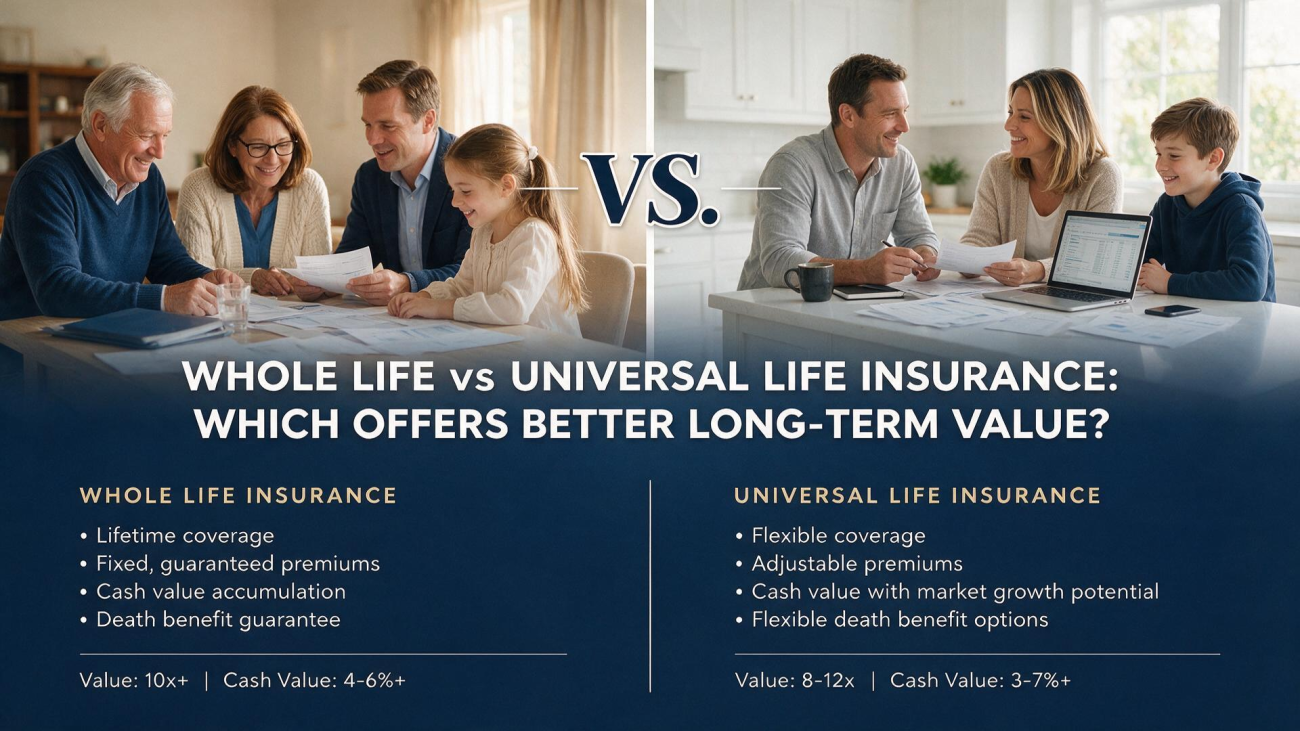
Two Permanent Policies, Two Very Different Promises
Walk into any conversation about permanent life insurance and you'll quickly hit the fork in the road: whole life or universal life. Both promise lifelong coverage. Both build cash value.
Both are significantly more expensive than term. But beneath those similarities, they operate on fundamentally different principles, and choosing between them is less about which is "better" and more about which set of trade-offs you can live with for decades. The whole life vs universal life insurance comparison is one of the most consequential decisions in personal finance, because the wrong choice can mean decades of premiums that don't deliver what you expected.The distinction comes down to guarantees versus flexibility. Whole life is built on certainty. Your premiums are fixed, your death benefit is guaranteed, and your cash value grows on a schedule the insurer sets in
advance [citation:1]. Universal life is built on adaptability. You can adjust your premiums, change your death benefit, and in some versions, invest your cash value in market-linked accounts . That flexibility sounds appealing, and it can be valuable in the right hands. But it also transfers risk from the insurer to you, and that risk can show up in unpleasant ways when you're older and the policy is harder to fix.Understanding the permanent life insurance comparison requires looking past the marketing materials and into the mechanics. What happens if you miss a premium? What happens if interest rates fall? What happens if you want to access your cash value? The answers differ dramatically between the two products, and those differences matter most when life doesn't go according to plan.
Whole Life: The Case for Certainty
Whole life insurance is the older, simpler product, and its simplicity is its main selling point. You pay a level premium for life, and in exchange, you get a guaranteed death benefit that never decreases as long as you pay your premiums. Your cash value grows on a guaranteed schedule, and if your policy is participating, you may receive dividends that can increase your cash value or death benefit over time [citation:1][citation:12]. There's no monitoring required, no investment decisions to make, and no risk of the policy imploding because the underlying assumptions didn't hold.
That predictability is valuable for people who want to "set it and forget it." If you're using life insurance for estate planning, funding a buy-sell agreement, or providing for a dependent with lifelong needs, the certainty of a whole life policy is exactly what you want [citation:2]. You know what you'll pay, you know what your beneficiaries will receive, and you know how the cash value will grow. The whole life insurance costs are higher than other options, but you're paying for guarantees that don't have an asterisk.
The dividend feature deserves attention for participating policies. Dividends aren't guaranteed, but the strongest mutual insurers have paid them for over a century, and they can meaningfully increase the policy's value over time [citation:12]. You can use dividends to pay premiums, accumulate more cash value, or purchase additional paid-up insurance that increases your death benefit. Over decades, that compounding can turn a modest policy into a substantial asset.
The downsides are equally clear. Whole life is expensive, and the cash value grows slowly in the early years because premiums first cover the cost of insurance and administrative expenses. If you surrender the policy in the first decade, you may get back less than you paid. The whole life insurance costs are fixed, which means you're locked in, and if your financial situation changes, the policy can become a burden rather than an asset.

Universal Life: The Flexibility Trade-Off
Universal life insurance was designed to address some of whole life's rigidity. Instead of fixed premiums, you have a flexible premium structure. You can pay more when money is good and less when it's tight, within limits. You can adjust your death benefit as your needs change. And depending on the type of universal life, your cash value may grow based on interest rates or market performance, offering potentially higher returns than whole life's guaranteed schedule .
The different flavors of universal life each come with their own risk profiles. Guaranteed universal life is the most conservative, offering a guaranteed death benefit with minimal cash value growth. Indexed universal life ties cash value growth to an index like the S&P 500, with caps on gains and a floor that protects against losses. Variable universal life lets you invest your cash value in subaccounts tied to the market, which offers the highest growth potential but also the highest risk [citation:3][citation:13]. The universal life insurance benefits vary enormously depending on which version you choose.
The critical issue with universal life is that the flexibility cuts both ways. If you underfund the policy, the cost of insurance charges will eat into your cash value, and the policy can lapse—often decades later, when you're older and less insurable. The death benefit isn't guaranteed unless you've purchased a no-lapse guarantee rider, and even then, you need to pay the minimum premium required to keep that guarantee in force [citation:1]. The universal life insurance benefits come with responsibilities that whole life doesn't require.
That's why universal life requires ongoing monitoring. You need to review the policy annually, check whether the cash value is growing as projected, and adjust your premiums if it isn't. If you're not willing to do that—or to pay someone to do it for you—universal life can be a trap. The life insurance investment options inside a variable or indexed policy can be attractive, but they require the same discipline as any other investment account.
The Math That Separates Them
Comparing whole life and universal life on cost alone is misleading, because they don't provide the same things. A whole life policy bundles guaranteed protection and guaranteed cash value growth into a single, fixed premium. A universal life policy separates those components, giving you more control but also more responsibility. The question isn't which is cheaper—it's which structure delivers more value for your specific situation.
The "buy term and invest the difference" argument looms over both products, and it's worth addressing honestly. Term insurance is dramatically cheaper than either permanent option, and if you invest the premium difference in a diversified portfolio, you'll likely end up with more wealth than either whole life or universal life would generate [citation:2][citation:7]. That argument holds when you have a temporary need for coverage, when you'll actually invest the difference, and when you're disciplined enough to stick with the plan.
But the argument breaks down when the need for coverage is permanent. If you're using life insurance for estate planning, to fund a special needs trust, or to cover estate taxes that will be due whenever you die, term insurance is structurally incompatible with the job. It expires, and the need doesn't [citation:2]. The life insurance investment options inside permanent policies also offer tax treatment that isn't available in taxable accounts, which can make them attractive for high earners who've maxed out other tax-advantaged vehicles.
For most people, the honest comparison isn't whole life versus universal life. It's whether permanent insurance of any kind makes sense, and if it does, which type fits your tolerance for risk and your willingness to manage the policy. The permanent life insurance comparison only matters after you've decided that permanent coverage is the right tool for the job.
Which One Fits Your Situation
Whole life tends to fit people who value certainty and don't want to manage another financial account. If you're using insurance for estate planning, if you want a guaranteed death benefit and a predictable cash value trajectory, and if you're comfortable paying a higher premium for those guarantees, whole life is the simpler choice. It's also the better choice if you know you won't want to monitor the policy regularly, because it doesn't require monitoring to keep working [citation:1].
Universal life tends to fit people who want flexibility and are willing to take responsibility for the policy's performance. If your income is variable, if you want the ability to adjust your coverage as your needs change, and if you're comfortable reviewing the policy annually and adjusting premiums as needed, universal life can offer more control. The whole life vs universal life insurance decision often comes down to whether you'd rather pay for certainty or manage for flexibility.
It's also worth considering the insurer's strength. With whole life, you're relying on the insurer's guarantees for decades. With universal life, you're relying on the insurer's guarantees and the performance of the cash value, which may depend on interest rates or market returns. In both cases, the financial strength of the carrier matters, but with universal life, the stakes are higher because the policy's viability depends on factors beyond the insurer's control .
Finally, be honest about your own behavior. If you're the kind of person who reviews your investment accounts regularly and adjusts as needed, universal life's flexibility might serve you well. If you prefer to set things up and leave them alone, whole life's guarantees are more likely to deliver what you expect. The whole life vs universal life insurance choice is as much about temperament as it is about math.
Getting the Decision Right
Neither whole life nor universal life is universally superior. The right choice depends on what you need the policy to do, how much certainty you want, and how much management you're willing to provide. What matters most is that you understand the trade-offs before you sign, because these are long-term commitments that are expensive and difficult to unwind.
Work with an advisor who can show you illustrations for both types of policies, based on your actual age, health, and goals. Ask questions about what happens if you miss a premium, if interest rates fall, or if you want to access your cash value. Read the policy carefully, and don't let anyone rush you. The life insurance investment options inside these products are complex, and complexity is where mistakes happen.
And remember that the best policy is the one you can afford to keep. A whole life policy that stretches your budget and gets surrendered in five years is worse than a universal life policy that's funded comfortably, or vice versa. The permanent life insurance comparison ultimately comes down to sustainability. Choose the policy you can hold for the long run, because that's the only way either type delivers its value.
