The Yield Trap That Catches Most REIT Investors
Ask a new REIT investor what they're looking for and the answer is almost always the same: a high dividend yield. It's an understandable instinct. REITs are required by law to distribute at least 90% of their taxable income to shareholders, which
makes them one of the most income-friendly investments available. But chasing the highest yield is one of the most reliable ways to lose money in this asset class. A yield that looks too good to be true usually is, because the market has already priced in a problem—a dividend that's about to be cut, a portfolio that's overleveraged, a property sector that's in structural decline. The REIT dividend yield that's worth owning is the yield that's sustainable, backed by real cash flow, and growing over time. Learning to tell the difference is the core skill of REIT investing.The distinction matters because REITs are fundamentally different from other dividend-paying stocks. They're pass-through entities, which means the dividend isn't a discretionary decision—it's a legal requirement. That structure has real benefits, but it also
means a REIT's dividend can be a trap if the underlying cash flow isn't sufficient to support it. A REIT that pays out more than it earns will eventually cut the dividend, and when that happens, the stock price typically falls sharply. The REIT dividend yield that's sustainable is the one that's covered by funds from operations, not the one that's funded by debt or asset sales.What makes this particularly important right now is that the REIT market is undergoing significant change. Certain sectors—office, traditional retail—are facing structural headwinds, while others—industrial, data centers, residential—are benefiting from long-term trends. The best REIT investments aren't the ones with the highest yields. They're the ones with the strongest underlying businesses, the best-positioned portfolios, and the most sustainable dividend growth. Finding them requires looking beyond the yield and understanding the metrics that actually matter.
Beyond Yield: The Metrics That Reveal Quality
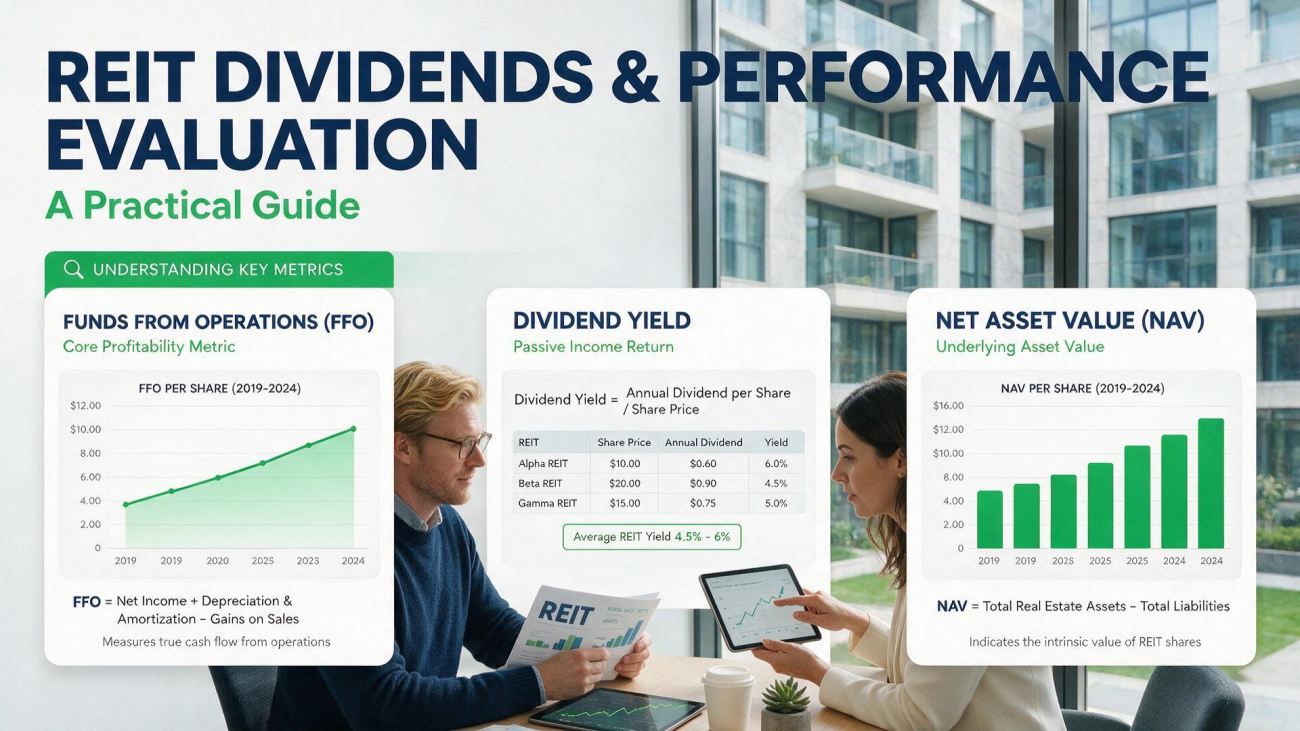
The first metric to understand is funds from operations, or FFO. It's the REIT equivalent of earnings, calculated by adding depreciation and amortization back to net income and subtracting gains from property sales. FFO is the cash flow that's available to fund dividends and reinvest in the business, and it's the number that analysts use to evaluate REIT performance. A REIT's FFO per share should be growing over time, and the dividend should be covered by FFO with room to spare. The REIT performance analysis that works starts with FFO, not with the dividend yield.
The payout ratio is the second critical metric. It's the dividend divided by FFO, expressed as a percentage. A payout ratio of 70% to 80% is generally considered healthy, because it leaves room for the REIT to retain some cash for reinvestment and to absorb a downturn in FFO without cutting the dividend. A payout ratio above 90% is a warning sign, because it leaves the REIT with little cushion if cash flow declines. The REIT dividend yield that's sustainable comes from a payout ratio that's conservative enough to survive a downturn.
The third metric is the leverage ratio, typically measured as debt to total assets or debt to EBITDA. REITs use leverage to acquire properties, and moderate leverage can enhance returns. But excessive leverage makes a REIT vulnerable to rising interest rates and declining property values. A leverage ratio that's too high is a red flag, because it means the REIT has less flexibility to weather a downturn and may be forced to cut the dividend or sell assets at a bad time. The REIT portfolio strategies that work avoid REITs with excessive leverage, even if their yields are attractive.
The fourth metric is the quality of the portfolio. What properties does the REIT own? Where are they located? Who are the tenants? What's the lease structure? A REIT with a portfolio of high-quality properties in strong markets, leased to creditworthy tenants on long-term leases, is a much safer investment than one with a portfolio of aging properties in declining markets leased to struggling tenants. The best REIT investments are the ones with the strongest property portfolios, not the ones with the highest yields.

Understanding the Sectors
The REIT market is divided into sectors, and each sector has its own risk and return profile. Understanding the sectors is essential for building a diversified REIT portfolio, because the different sectors respond differently to economic conditions. A portfolio that's concentrated in one sector is vulnerable to a downturn in that sector, while a portfolio that's diversified across sectors is more resilient.
Residential REITs own apartments and single-family rentals. They benefit from population growth, household formation, and a shortage of housing supply. Their demand is relatively stable, because people always need a place to live, though they're sensitive to job losses and rent affordability. Industrial REITs own warehouses and logistics facilities, and they've benefited enormously from the growth of e-commerce. Their demand is driven by retailers' need for distribution space, which makes them sensitive to consumer spending and trade flows. The REIT performance analysis that works evaluates each sector's fundamentals, not just the yield.
Retail REITs own shopping centers, malls, and free-standing retail properties. They've been under pressure from e-commerce, but the strongest retail REITs have adapted by focusing on necessity-based retail, experiential retail, and properties in strong demographic markets. Office REITs own office buildings, and they're facing the most significant structural challenge as remote work reduces demand for traditional office space. Data center REITs own the facilities that house the servers and infrastructure that power the internet, and they've benefited from the growth of cloud computing and artificial intelligence. Healthcare REITs own medical offices, hospitals, and senior living facilities, and they benefit from aging demographics. The REIT portfolio strategies that work spread the allocation across sectors with strong fundamentals, rather than concentrating in the ones that have performed best recently.
It's also worth understanding the different REIT structures. Equity REITs own physical properties and generate income from rent. Mortgage REITs, or mREITs, own mortgages and mortgage-backed securities and generate income from the interest spread. The two have very different risk profiles. Equity REITs are sensitive to property market conditions, while mREITs are sensitive to interest rate movements and credit conditions. The best REIT investments for income-oriented investors are often equity REITs, because their dividends are backed by real property cash flow, while mREITs can offer higher yields but with much higher risk.
Evaluating Dividend Safety and Growth
The most important question for a REIT investor is whether the dividend is safe. A high yield is meaningless if the dividend is about to be cut. Evaluating dividend safety requires looking at the payout ratio, the FFO growth trajectory, the leverage ratio, and the quality of the portfolio. A REIT with a low payout ratio, growing FFO, moderate leverage, and a strong portfolio is much more likely to maintain its dividend through a downturn than one with the opposite characteristics. The REIT dividend yield that's safe is the one that's backed by those fundamentals.
Dividend growth is the second consideration. A REIT that raises its dividend consistently over time is a much better investment than one that pays a high but stagnant yield, because the growing dividend provides protection against inflation and a rising income stream over time. Many REITs have long track records of dividend increases, and those track records are a useful signal of management's commitment to shareholders and the quality of the underlying business. The REIT performance analysis that works looks at the dividend growth history, not just the current yield.
It's also worth considering the tax treatment of REIT dividends. REIT dividends are generally taxed as ordinary income, which is the highest rate for most investors, though a portion may qualify for the 20% pass-through deduction under Section 199A. That tax treatment makes REITs less attractive in taxable accounts than in tax-advantaged accounts, which is why the REIT portfolio strategies that work often hold REITs in retirement accounts and other tax-deferred vehicles. The after-tax yield is what matters, not the headline yield.
Finally, it's worth evaluating the REIT's management team. REITs are managed by teams that make decisions about acquisitions, dispositions, development, and capital allocation. A strong management team can create value over time, while a weak one can destroy it. Look at the team's track record, their compensation structure, and their alignment with shareholders. The best REIT investments are the ones with management teams that have a proven ability to allocate capital effectively and to navigate market cycles.
Building a Diversified REIT Portfolio
A diversified REIT portfolio spreads the allocation across sectors, geographies, and management teams. That diversification reduces the risk that any single sector or REIT will drag down the overall portfolio, and it provides exposure to different growth drivers. The REIT portfolio strategies that work include a mix of sectors with strong fundamentals—industrial, residential, data centers, healthcare—alongside smaller allocations to sectors that are out of favor but may be poised for recovery.
The portfolio should also include a mix of REIT sizes. Large-cap REITs offer stability, liquidity, and access to institutional-quality properties, while small-cap REITs offer higher growth potential but with more risk. A portfolio that includes both is more diversified than one that's concentrated in either. The REIT dividend yield that's sustainable across the portfolio comes from the blend of large, stable REITs and smaller, growth-oriented ones.
It's also worth considering the role of REITs within a broader real estate allocation. REITs provide liquidity and diversification that direct property ownership can't match, which makes them a valuable complement to a direct property portfolio. The REIT performance analysis that works compares the REIT allocation to the direct property allocation, to make sure the overall portfolio is balanced and diversified.
Finally, review the portfolio regularly. The REIT market changes, the sectors rotate, and the individual REITs evolve. A portfolio that was well-positioned five years ago may be concentrated in the wrong sectors today. The best REIT investments are the ones that are reviewed and adjusted as conditions change, not the ones that are bought and forgotten. Take the time to understand the metrics, evaluate the sectors, and build a diversified portfolio that can weather the cycles. That's the path to sustainable REIT income, and it's the path that avoids the yield traps that catch most investors.
