Two Policies, Two Different Jobs
Business owners often confuse general liability and professional liability insurance, and the confusion is understandable. Both are called liability insurance, both protect against claims, and both
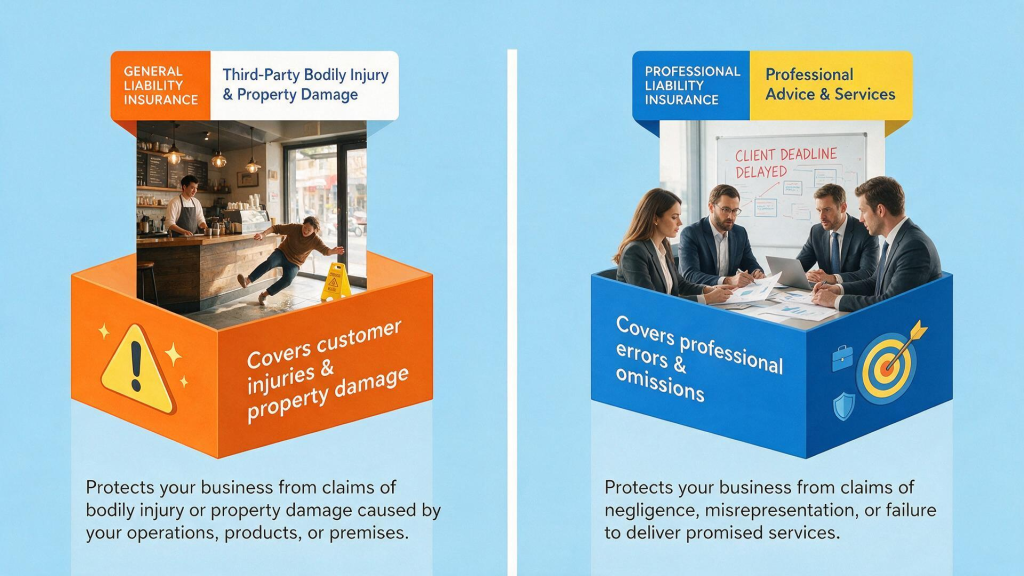
are sold by the same agents. But they cover fundamentally different things, and assuming one will cover a claim that the other is designed for is a mistake that can cost a business dearly. The general liability insurance versus professional liability insurance distinction isn't a technicality. It's the difference between coverage that pays and coverage that denies when you need it most.The simplest way to frame it is this: general liability covers physical harm and property damage, while professional liability covers financial harm caused by your expertise. If someone slips on
your wet floor and breaks an arm, that's general liability. If a client follows your advice and loses money, that's professional liability. The business liability insurance comparison that matters isn't about which policy is better. It's about which policy covers the specific risks your business creates, and most businesses need both because most businesses create both kinds of risk.What makes this particularly important is that the two policies don't overlap. A general liability policy won't cover a claim that your professional services caused financial harm, and a professional liability policy won't cover a slip-and-fall in your lobby. If you only have one and the claim falls into the other category, you're paying out of pocket, and the amounts involved can be large enough to threaten the business. The commercial liability coverage that works for a business is the coverage that addresses all the ways the business can be held liable, not just one category.
What General Liability Insurance Covers
General liability insurance, often called commercial general liability or CGL, covers claims of bodily injury and property damage that arise from your business operations or premises. If a customer trips on a loose rug in your store, general liability covers the medical bills and the lawsuit. If your employee accidentally damages a client's property while making a delivery, general liability covers the repair. If a third party is injured on your job site, general liability covers the claim. The policy is designed to protect the business from the physical risks that come with operating a physical space or providing a physical service.
The coverage also includes personal and advertising injury, which protects against claims of libel, slander, copyright infringement, and other reputational harms. If a competitor sues you for false advertising, general liability may cover the defense. That's a broad category, and it's one of the reasons general liability is considered foundational for most businesses. The general liability insurance policy is the first one most businesses buy, and it's often required by landlords, clients, and contracts.
The typical general liability policy covers legal defense costs, settlements, and judgments up to the policy limit. It doesn't cover the cost of repairing your own property—that's property insurance—and it doesn't cover employee injuries—that's workers' compensation. It also excludes professional services, which is where professional liability comes in. The liability insurance costs for general liability are relatively low for most small businesses, often a few hundred to a few thousand dollars a year, because the risks it covers are well-understood and the claims tend to be smaller than professional liability claims.
It's worth understanding the limits of general liability. The policy doesn't cover everything. It typically excludes intentional acts, criminal acts, and claims arising from professional services. It also excludes pollution, auto accidents, and employee injuries. Those exclusions are standard, and they're why businesses need other policies to fill the gaps. The business liability insurance comparison should include a review of the exclusions, because the gaps are where the surprises live.
What Professional Liability Insurance Covers
Professional liability insurance, also called errors and omissions insurance or E&O, covers claims that your professional advice or services caused a client financial harm. If a consultant recommends a strategy that loses the client money, professional liability covers the claim. If an accountant makes an error on a tax return that triggers a penalty, professional liability covers the claim. If an architect designs a building that has to be rebuilt, professional liability covers the claim. The policy is designed to protect the business from the risks that come from providing expert services, where the client relies on your judgment and your work.
The coverage is essential for any business that provides professional services, including lawyers, accountants, consultants, architects, engineers, healthcare providers, financial advisors, and technology companies that provide services rather than products. Without it, a single claim can destroy a business, because the damages can be large and the legal defense costs can be enormous. The professional liability insurance policy is often required by clients, especially in industries where the financial harm from a mistake can be significant.
Professional liability policies vary widely by industry. A lawyer's malpractice policy is different from a technology company's E&O policy, which is different from a healthcare provider's malpractice policy. The coverage terms, the exclusions, and the limits reflect the specific risks of the profession. That's why a generic professional liability policy may not be adequate for a specialized business. The commercial liability coverage that works for a professional services firm is tailored to the specific services it provides and the specific risks those services create.
The cost of professional liability insurance varies enormously by profession and by the size of the business. A small consulting firm might pay a few thousand dollars a year, while a law firm with multiple partners might pay tens of thousands. The liability insurance costs reflect the potential damages, the likelihood of claims, and the legal environment of the profession. For businesses in high-risk professions, the cost can be significant, but it's usually small relative to the potential loss from a single claim.
Why Most Businesses Need Both
The most common mistake business owners make is assuming that one policy covers everything. It doesn't. General liability and professional liability cover different risks, and a claim that falls into one category won't be covered by the other. A business that provides both physical services and professional advice—like a contractor who designs and builds, or a healthcare provider who treats patients and advises them—needs both policies. The business liability insurance comparison should start with an assessment of the risks the business actually creates, not with a comparison of premiums.
The overlap between the two policies is minimal, but there are some edge cases where the line is blurry. A claim that involves both a physical injury and a professional error—like a patient who is injured during a procedure that was also performed negligently—might trigger both policies. In those cases, the policies may share the defense costs or coordinate coverage, but the details depend on the specific policy language. The general liability insurance and professional liability insurance policies should be reviewed together to make sure there are no gaps in coverage.
It's also worth considering the umbrella policy. An umbrella liability policy provides additional coverage above the limits of the underlying general liability and professional liability policies, and it can fill gaps between the two. For businesses with significant exposure, an umbrella policy is often a cost-effective way to increase coverage without buying separate policies for every risk. The commercial liability coverage that works for a business with substantial risk includes an umbrella policy as part of the overall program, not as an afterthought.
The cost of carrying both policies is higher than carrying one, but the cost of a claim that isn't covered is far higher. A business that saves a few thousand dollars a year on premiums by dropping one policy can lose everything if the wrong claim comes in. The liability insurance costs should be evaluated against the potential loss, not just against the budget. For most businesses, the coverage is worth the cost, and the peace of mind is worth something too.
How to Choose the Right Coverage
The first step is to assess the risks your business actually creates. If you operate a physical space, if you have employees, if you interact with customers in person, you need general liability. If you provide professional advice or services, if your clients rely on your expertise, if a mistake could cause them financial harm, you need professional liability. Most businesses need both, and the assessment should be honest about which risks are real and which are theoretical. The business liability insurance comparison should be based on that assessment, not on what other businesses in your industry buy.
The second step is to choose the right limits. The limits should be high enough to cover the potential damages from a claim, plus the legal defense costs. For general liability, the standard limits are $1 million per occurrence and $2 million aggregate, though higher limits are available and often advisable. For professional liability, the limits should reflect the potential financial harm from a mistake, which can be much higher in some professions. The professional liability insurance limits should be set with the advice of a broker who understands the industry, not just picked from a menu.
The third step is to work with a broker who specializes in your industry. A generalist agent may be able to sell you a policy, but a specialist knows the risks your industry faces, the coverages that are standard, and the insurers that are most competitive for your specific business. The general liability insurance and professional liability insurance that work for a business are the policies that are tailored to its specific risks, not the ones that are sold off a shelf. The broker's expertise is often the difference between adequate coverage and a gap that only becomes apparent when a claim is filed.
And it's worth reviewing the coverage annually. As the business grows and changes, the risks change too. A policy that was adequate when the business was small may be inadequate when it's larger. A policy that covered one type of service may not cover a new service the business has added. The commercial liability coverage that works is the coverage that's reviewed and updated regularly, not the coverage that's purchased once and forgotten. Take the time to get it right, and review it every year. That's the difference between coverage that protects the business and coverage that just feels like a cost.
