
Why Commercial Real Estate Rewards Patience and Punishes Overconfidence
Commercial real estate has long been one of the most reliable vehicles for building serious wealth in America. Office towers, apartment complexes, retail centers, and industrial warehouses have created fortunes for generations
of investors, and the asset class continues to attract capital from institutions, family offices, and high-net-worth individuals alike. But the returns don't come easily or automatically. Commercial real estate is unforgiving to investors who underestimate its risks, overleverage their positions, or misjudge the market. The commercial real estate investment that works is the kind that's built on a clear understanding of what drives returns, what threatens them, and how to finance the acquisition in a way that survives a downturn.The asset class is fundamentally different from residential real estate. Commercial properties are valued based on the income they produce, not on comparable sales the way homes are. That income-based valuation
means the property's value is directly tied to the tenant's ability to pay rent, which in turn depends on the health of the tenant's business. A single tenant's bankruptcy can wipe out the income stream and destroy the property's value. The commercial real estate returns that investors chase are a function of that income, plus appreciation, minus the costs of ownership and financing.What makes this particularly important right now is that the commercial real estate market is undergoing significant change. Remote work has reduced demand for office space in many markets. E-commerce has reshaped the retail sector. Interest rate increases have raised the cost of financing and lowered property valuations. The commercial property investment risks that investors face today are different from the ones they faced a decade ago, which is why a fresh assessment of the risks and returns is essential before committing capital.
Understanding the Sources of Return
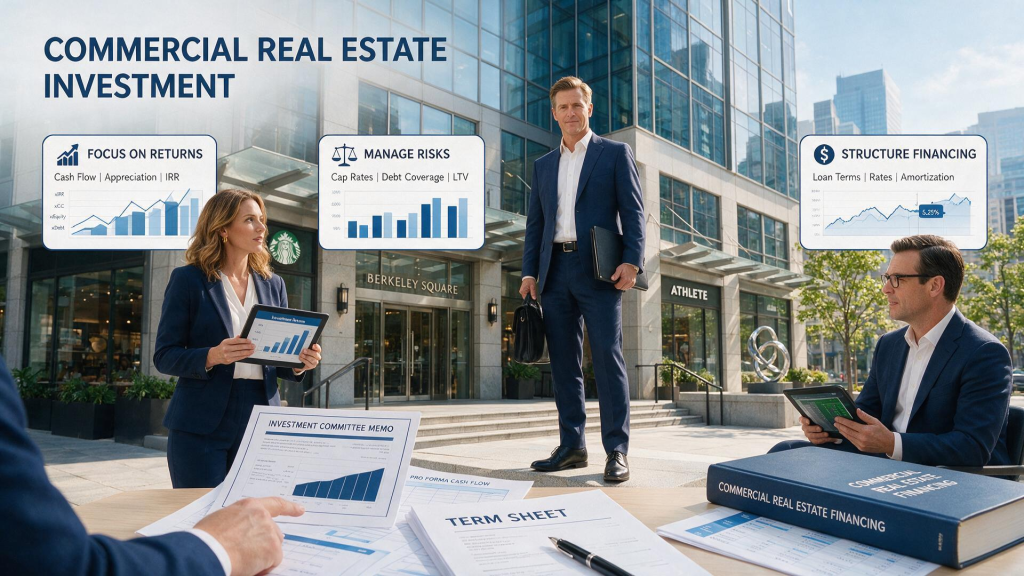
Commercial real estate returns come from three primary sources: income, appreciation, and the use of leverage. Income is the most predictable and the most important. A well-located property with strong tenants and long-term leases produces a steady stream of rental income that can be used to service debt, pay expenses, and distribute to investors. The commercial real estate returns that investors rely on are largely driven by that income, and the stability of the income depends on the quality of the tenants and the terms of the leases.
Appreciation is the second source of return. Commercial properties can increase in value over time as rents rise, as the surrounding area improves, or as the property is repositioned to a higher and better use. That appreciation is realized when the property is sold, or it can be captured through a refinancing if the property's value has increased. The commercial property financing that's structured well can allow the investor to extract equity as the property appreciates, which is one of the ways that commercial real estate builds wealth more efficiently than other asset classes.
Leverage is the third source of return, and it's the one that requires the most caution. Commercial real estate is typically financed with debt, and that debt amplifies both the returns and the risks. A property that produces a 7% unlevered return can produce a 12% levered return if the debt costs 4% and the property is financed at 60% loan-to-value. But the same leverage can turn a 10% decline in value into a 25% decline in equity. The commercial real estate loans that work are the ones that are sized conservatively, with enough equity cushion to absorb a decline in value without triggering a default.
The interaction between those three sources of return is what makes commercial real estate both attractive and complicated. A property with strong income and modest leverage can produce reliable returns through a downturn. A property with weak income and aggressive leverage can produce spectacular returns in a strong market but can be wiped out in a downturn. The commercial real estate investment that works for a long-term investor is the one that prioritizes durability over maximum returns, because the goal is to build wealth over decades, not to chase the highest possible number in any single year.
The Risks That Matter Most
The most significant risk in commercial real estate is tenant risk. A property's income depends on its tenants' ability to pay rent, and a tenant's ability to pay depends on the health of its business. A single-tenant property, like an office building leased to one company, is entirely dependent on that company's solvency. A multi-tenant property with a diverse tenant roster is more resilient, but it's still exposed to the risk that a major tenant will vacate or go bankrupt. The commercial property investment risks that investors need to understand start with the quality and diversity of the tenant base.
Market risk is the second major risk. Commercial property values are driven by the supply and demand for space in the local market. A market with strong job growth and population gains will support rising rents and property values. A market with economic decline or an oversupply of space will see falling rents and declining values. The commercial real estate returns that investors earn are shaped by the market they invest in, and no amount of property-level management can overcome a declining market.
Interest rate risk is the third major risk. Commercial properties are typically financed with debt, and the cost of that debt affects both the property's cash flow and its value. When rates rise, the cost of financing increases, and the property's value may decline because the capitalization rate used to value it increases. The commercial real estate loans that are structured with fixed rates and long terms protect the investor from that risk, while floating-rate loans expose the investor to rising payments that can eat into cash flow.
Liquidity risk is the fourth major risk. Commercial properties are illiquid, and selling one can take months or years. In a downturn, when buyers are scarce and credit is tight, the property may be impossible to sell at any reasonable price. The commercial real estate investment that works is the one that's funded with capital that doesn't need to be liquidated quickly, and that's structured to hold through a downturn rather than being forced to sell at the bottom.
Financing Options That Fit the Investment
The financing of a commercial property is as important as the property itself. The wrong financing can turn a good investment into a bad one, and the right financing can turn a mediocre investment into a good one. The commercial property financing market offers a range of options, and the right choice depends on the property's characteristics, the investor's goals, and the market conditions at the time of the acquisition.
Traditional bank loans are the most common source of financing for commercial properties. Banks typically lend at 60% to 75% loan-to-value, with terms of five to ten years and amortization schedules of twenty to thirty years. They require the borrower to have a strong credit history, significant equity in the property, and a debt service coverage ratio that demonstrates the property's income can cover the debt payments. The commercial real estate loans that banks provide are typically the most affordable option for well-qualified borrowers with stable properties.
Commercial mortgage-backed securities, or CMBS, are another option. CMBS loans are pooled into securities and sold to investors, which allows lenders to offer more competitive terms and higher leverage than traditional banks. They're often used for larger properties or for borrowers who need more leverage than a bank will provide. The trade-off is that CMBS loans are more complex, less flexible, and often come with prepayment penalties that limit the borrower's ability to refinance. The commercial property financing that uses CMBS is better suited for investors who plan to hold the property for the full term of the loan.
Life insurance company loans are a third option. Life companies lend at lower leverage than banks or CMBS lenders, but they offer longer terms and more predictable pricing. They're typically used for high-quality properties with strong tenants and long-term leases. The commercial real estate loans that life companies provide are attractive for investors who want stability and predictability rather than maximum leverage.
It's also worth considering seller financing and mezzanine debt as part of the capital structure. Seller financing can bridge a gap in the capital stack and can be particularly useful in markets where traditional financing is difficult to obtain. Mezzanine debt sits between the senior mortgage and the equity, providing additional leverage at a higher cost. The commercial real estate investment that uses those tools needs to understand the risks they introduce, because the more leverage in the capital stack, the more fragile the investment becomes in a downturn.
Building a Strategy That Survives the Cycle
The investors who succeed in commercial real estate are the ones who think in decades, not quarters. They buy quality properties in strong markets, finance them conservatively, and hold them through the cycle. They don't chase the highest returns in the best of times, because they know that the best of times don't last. The commercial real estate returns that compound over a long holding period are more valuable than the highest returns in any single year.
That doesn't mean being passive. Good commercial real estate investors are actively involved in managing their properties, negotiating leases, and repositioning assets when the market changes. They understand that the property's income isn't fixed—it can be increased through better management, capital improvements, or a change in use. The commercial real estate investment that works is the one where the investor is engaged with the asset, not just collecting rent.
It's also worth diversifying across property types and markets. A portfolio that's concentrated in office space in a single city is vulnerable to the changes in that sector and that market. A portfolio that includes industrial, multifamily, and retail properties across several markets is more resilient. The commercial property investment risks that matter most are the ones that are concentrated, and diversification is the most reliable way to reduce them.
Finally, the financing should be structured to survive a downturn. That means conservative leverage, fixed rates, and long maturities. The commercial real estate loans that work are the ones that don't come due during a credit crunch, and that don't reprice when rates rise. A property that's financed with a ten-year fixed-rate loan at 60% loan-to-value can survive a downturn that would wipe out a property financed with a short-term floating-rate loan at 80% loan-to-value. The goal isn't to maximize returns in the good times; it's to preserve the investment through the bad times and capture the returns when the cycle turns.
