Think about the last time you bought something online and didn't have to leave the site to pay. Or the time you financed a purchase directly from a retailer's checkout page without
filling out a separate loan application. Or the ride-share app that lets you pay the driver without ever entering a card number. That's embedded finance, and it's been quietly rewiring how money moves through the economy for years now. The phrase itself is industry jargon, but the phenomenon is something consumers encounter constantly, often without realizing that a financial service is happening at all.What Embedded Finance Actually Is
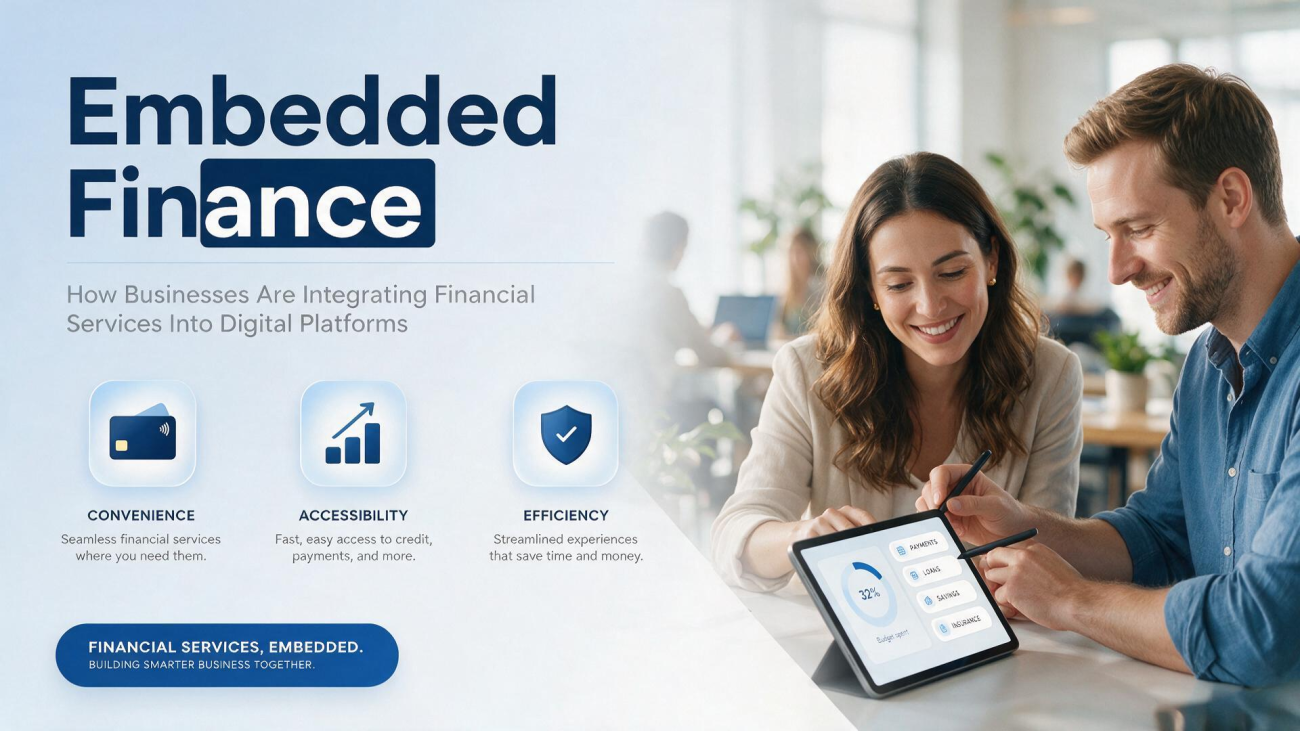
The basic definition is straightforward. Embedded finance is the integration of financial services into non-financial platforms and applications. The financial product—a payment, a loan, an insurance
policy, a bank account—is delivered inside a context where the customer is already doing something else. A retailer embedding a buy-now-pay-later option at checkout is doing embedded finance. A software platform offering a small business loan based on the transactions it processes is doing embedded finance. A car manufacturer bundling insurance into the purchase of a vehicle is doing embedded finance.The key insight is that the financial service becomes invisible. The customer isn't opening a new bank account or applying for a loan in the traditional sense. They're making a purchase, and the financing is just part of the experience. That matters because the friction of traditional financial services is enormous. Applications, credit checks, approval waits, paperwork—all of it adds time and hassle. Embedded finance strips that away by moving the financial decision to the moment of need, inside a platform the customer already trusts.
The embedded finance market has grown rapidly because it solves a real problem for both sides. For the platform, it's a new revenue stream and a way to deepen customer relationships. For the consumer, it's convenience. For the financial institution behind the scenes, it's a distribution channel that reaches customers it couldn't access directly. That three-way alignment is why the model has spread from e-commerce into healthcare, real estate, logistics, and dozens of other industries.
What makes it possible is a layer of technology that didn't exist a decade ago. Banks, payment processors, and other financial institutions now offer their capabilities as APIs—building blocks that any platform can plug into. A software company that wants to offer payments to its customers doesn't need to become a bank. It just needs to connect to one. That's the infrastructure that banking as a service providers have built, and it's the foundation on which the entire embedded finance ecosystem rests.
The Business Case for Platforms
Why are so many companies rushing to embed financial services? The straightforward answer is revenue. Payments, lending, and insurance all generate fees, and those fees can be substantial when you're processing transactions at scale. A platform that already has millions of users can add a meaningful new revenue line by offering a financial product, often with better margins than its core business. That's especially attractive for companies with thin margins or expensive customer acquisition costs, because the financial product monetizes a relationship that already exists.
But the deeper reason is engagement. Financial services tend to increase how often customers use a platform and how deeply they integrate it into their lives. A small business that uses a software platform for invoicing, payroll, and payments is much harder to displace than one that just uses it for invoicing. The financial products create switching costs, which are the holy grail of software businesses. That's why so many platforms have moved beyond their original function into financial services—it's a retention strategy as much as a revenue strategy.
Customer data is the third driver, and it's the one that makes some regulators nervous. A platform that sees a business's transactions, cash flow, and customer base has a much richer picture of that business's creditworthiness than a traditional lender does. That information advantage allows for faster, better-underwritten loans, which is genuinely valuable to the borrower. But it also creates a power imbalance that has to be managed carefully, especially when the platform is both the lender and the primary system of record for the borrower's business.
The embedded banking solutions that have emerged in response are increasingly sophisticated. Early versions were mostly payments and simple lending. Now platforms are offering deposit accounts, treasury management, insurance, and even investment products. The boundaries between a software company and a financial institution are blurring, and the companies that get this right are building something that looks less like a traditional bank and more like an operating system for a particular industry.
The Infrastructure Layer Nobody Sees
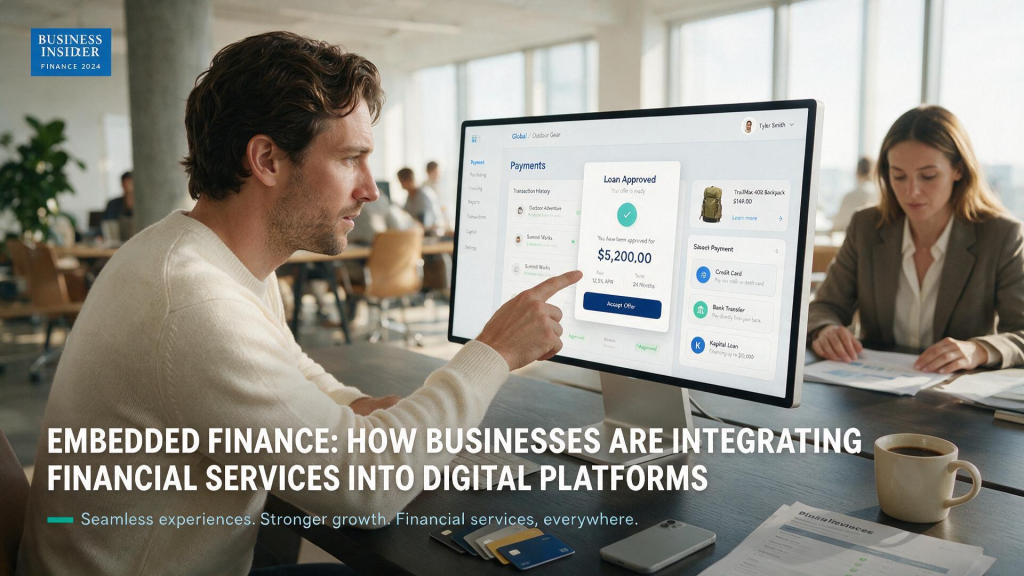
Behind every embedded finance product is a chain of providers that most customers never think about. A retailer offering buy-now-pay-later isn't lending its own money. It's partnering with a lender, a payment processor, a credit decisioning engine, and a compliance provider, all coordinated through APIs. That infrastructure layer is where much of the innovation is happening, and it's where the real competition is playing out.
The fintech payment solutions that power embedded finance have evolved rapidly to support this model. Payment processors now offer white-labeled solutions that platforms can integrate with minimal development work. Lending-as-a-service providers handle origination, underwriting, and servicing, leaving the platform to focus on the customer experience. Card-issuing platforms allow any company to launch a branded card without becoming a bank. The specialization has made it possible for companies without financial expertise to offer sophisticated financial products, which is why embedded finance has spread so quickly.
The regulatory complexity is the hidden cost of this model. Every financial product is regulated, and the regulations vary by state and by country. The platform that embeds a lending product has to ensure that the underlying lending partner is compliant, that disclosures are accurate, and that fair lending rules are followed. Most platforms don't have the expertise to manage this themselves, which is why they lean heavily on their infrastructure partners. The quality of those partners is a critical factor in whether an embedded finance program succeeds or fails.
The digital financial infrastructure that has emerged to support all of this is becoming more robust, but it's still evolving. There are real questions about resilience, about concentration risk when a small number of providers serve most of the market, and about what happens when something breaks. The industry has mostly been lucky so far, but a major outage at a key infrastructure provider would be a wake-up call. The companies that are building embedded finance carefully, rather than racing to launch, are thinking about these risks.
The Consumer Experience and Its Trade-Offs
From the consumer side, embedded finance is mostly a story of convenience. Paying at checkout without leaving the site, financing a purchase without a separate application, insuring a rental car with one click—these are genuine improvements over the alternative. The friction of traditional financial services has always been a tax on time and attention, and embedded finance reduces that tax. For consumers who are unbanked or underbanked, embedded finance can also be a path to services they couldn't access otherwise.
But there are trade-offs, and they deserve honest attention. The first is that financial decisions are easy to make impulsively when they're embedded in a shopping experience. Buy-now-pay-later is a good example. It's genuinely useful for some purchases, but it also makes it easy to spend money you don't have. The convenience that makes embedded finance appealing also makes it harder to step back and think about whether a financial decision is a good one. That's a real concern, and it's why consumer advocates have pushed for clearer disclosures and stronger protections.
The second is data privacy. Embedded finance requires the platform to share data with its financial partners, and that data can be extensive. A platform that processes your business's transactions has a detailed view of your cash flow, your customers, and your suppliers. When it partners with a lender, that data flows to the lender, which may use it for its own purposes. Consumers and business owners should understand what data is being shared and with whom, and the better platforms are transparent about their practices. The ones that bury it in a long agreement are telling you something.
The third is the risk of over-extension. When every platform offers a financial product, consumers can find themselves with multiple loans, cards, and accounts that are hard to track. The ease of embedding financial services can lead to a fragmented financial life that's harder to manage, not easier. The embedded finance industry hasn't fully grappled with this, and it's one of the reasons regulators are paying close attention. Convenience is valuable, but it needs to be paired with tools that help consumers see the whole picture.
Where the Market Is Heading
The trajectory is fairly clear. Embedded finance will continue to expand beyond payments and lending into insurance, investing, and wealth management. More industries will adopt it—healthcare, education, logistics, agriculture. The infrastructure layer will consolidate as providers scale, which will make integration easier and lower the barrier to entry for platforms that want to offer financial services. The consumer experience will become more seamless, and financial services will become even more invisible.
What's less clear is how the regulatory landscape will evolve. The current framework was built for a world where financial services were offered by financial institutions, and it doesn't fit neatly onto a world where they're offered by software companies, retailers, and marketplaces. Regulators are working through this, and the outcome will shape which business models are viable. The banking as a service providers that have invested in compliance infrastructure are better positioned for whatever comes, because they can help their platform partners navigate the rules.
For businesses considering embedded finance, the practical advice is to start with a clear understanding of the customer problem you're solving. The platforms that have succeeded didn't add financial services because it was trendy. They did it because their customers needed financing, or payments, or insurance, and offering it inside the platform was the best way to deliver. The digital financial infrastructure is now mature enough that almost any platform can offer financial services. The differentiator is whether the service actually makes the customer's life better, or whether it's just a new revenue line that adds complexity.
For consumers, the advice is to pay attention. Embedded finance is convenient, and convenience is worth something. But every financial decision is still a decision, and the ease of making it shouldn't obscure the need to think about it. The embedded banking solutions that will define the next decade are the ones that make financial services not just easy, but understandable. That's a higher bar than most of the market is currently clearing, and it's the one that will separate the platforms that earn trust from the ones that just extract value.
