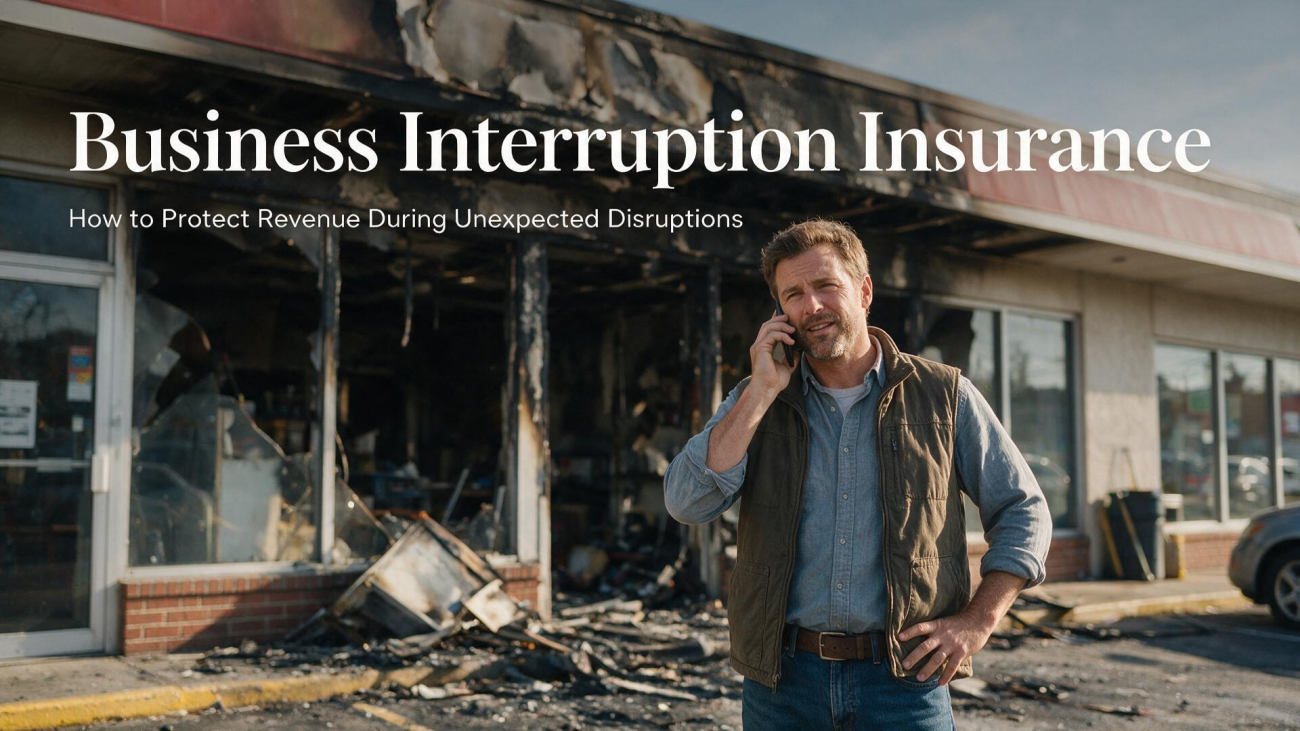
The Coverage That Keeps the Lights On When the Doors Close
Imagine a fire forces your business to shut down for three months. The property insurance pays to repair the building and replace the equipment. But what pays the rent while the
building is empty? What pays the salaries of the employees who are still on the payroll? What replaces the revenue that would have come in during those three months? The answer, for businesses that have it, is business interruption insurance. For businesses that don't, the answer is often a permanent closure. The business interruption insurance coverage is one of the most overlooked and most valuable policies a business can own, because it addresses the risk that a physical loss turns into a financial one.The statistics are sobering. According to the Federal Emergency Management Agency, roughly 25% of businesses never reopen after a major disaster, and those that do often
struggle to recover. The reason isn't usually that the physical damage was uninsured. It's that the lost revenue and ongoing expenses during the shutdown were more than the business could absorb. The business income insurance that covers those losses is the difference between a business that survives the disruption and one that doesn't.What makes this particularly important right now is that disruptions are becoming more frequent and more varied. Fires and natural disasters are the traditional triggers, but businesses are increasingly facing shutdowns from supply chain failures, utility outages, civil unrest, and government-mandated closures. The business interruption coverage that works for a modern business needs to address a broader range of scenarios than the policies of a generation ago, which is why understanding the coverage terms is more important than ever.
What Business Interruption Insurance Actually Covers
The core of a business interruption policy is the replacement of lost income. When a covered event forces the business to suspend operations, the policy pays the profit the business would have earned during the period of restoration. That's the revenue minus the expenses that would have been incurred to generate that revenue. The coverage is typically calculated based on historical financial records, with the policy paying for the income that would have been earned during the shutdown period, up to the policy limit .
The coverage also includes continuing operating expenses. Even when the business is closed, many costs continue: rent, mortgage payments, insurance premiums, taxes, and some salaries. The policy can cover those expenses, which is critical because they're the ones that drain cash reserves during a shutdown. Some policies also cover extra expenses—the costs of operating from a temporary location, renting equipment, or paying overtime to get back up and running faster. The commercial insurance protection that works includes all three components: lost income, continuing expenses, and extra expenses.
The trigger for the coverage matters enormously. Most traditional business interruption policies require physical damage to the insured property as the trigger. If a fire damages the building and forces a closure, the policy responds. But if the business is closed because of a government order, a supply chain failure, or a pandemic, the policy may not respond unless it has specific endorsements for those scenarios. The business interruption insurance that works for a modern business includes endorsements for the disruptions that are most likely to affect it, not just the traditional physical damage scenarios.
It's also worth understanding the period of restoration. That's the time between the event and the point when the business can resume normal operations, and it's the period the policy covers. If the restoration takes longer than expected, the coverage continues until the policy limit is exhausted. If the business can reopen sooner than expected, the coverage stops. The business continuity risk management that works includes a realistic assessment of how long it would take to recover from a disruption, because the policy limit needs to be adequate to cover that period .

The Endorsements That Fill the Gaps
Traditional business interruption policies have gaps that modern businesses can't afford to ignore. The most significant is the requirement for physical damage. If a business is forced to close because a key supplier fails, because a utility outage shuts down the area, or because a government order mandates closure, the standard policy may not respond. The endorsements that fill those gaps are essential for businesses with significant exposure to those risks.
Contingent business interruption coverage responds when a supplier, customer, or other business partner suffers a disruption that affects your business. If your main supplier's factory burns down and you can't get the materials you need, contingent business interruption covers the lost income. Civil authority coverage responds when a government order prevents access to your business, such as during a natural disaster or a security incident. Utility service interruption coverage responds when a power outage or other utility failure shuts down your operations. The business income insurance that's adequate for a business with complex dependencies includes those endorsements, because the standard policy doesn't cover them .
There's also the question of how the coverage is calculated. Some policies use a gross earnings basis, which pays based on revenue minus certain variable costs. Others use a gross profit basis, which accounts for all the expenses that continue during a shutdown. The choice affects both the premium and the payout, and the right basis depends on the business's cost structure and its exposure. The business interruption coverage that works is the coverage that's calculated on the basis that matches the business's actual loss experience, not the basis that produces the lowest premium.
It's also worth considering the waiting period, which is the time the business has to be closed before the coverage kicks in. A typical waiting period is 72 hours, though it can be longer for certain types of events. A longer waiting period lowers the premium but increases the business's exposure to short disruptions. The commercial insurance protection that's appropriate for a specific business reflects its ability to absorb short disruptions and its need for coverage on longer ones.
How Much Coverage Do You Need
Determining the right amount of business interruption coverage requires a realistic assessment of the business's income and expenses. The coverage limit should be high enough to cover the income that would be lost during the longest plausible shutdown period, plus the continuing expenses and the extra expenses of recovery. For a business with a single location and a straightforward operation, that might be six months of income. For a business with complex operations, multiple locations, and significant supply chain dependencies, it might be twelve months or more.
The calculation isn't just about the revenue. It's about the profit that would have been earned, because that's what the policy replaces. A business with high revenue but thin margins needs less coverage than one with lower revenue but higher margins, because the profit at risk is different. The business income insurance limit should be based on the profit and continuing expenses, not on the revenue alone .
It's also worth considering the extra expenses that might be incurred to speed recovery. A business that can relocate to a temporary location and keep operating might lose less income than one that has to wait for its building to be repaired. The extra expense coverage pays for those temporary measures, and it can be a cost-effective way to reduce the overall loss. The business continuity risk management that works includes a plan for temporary operations, and the insurance should cover the costs of executing that plan.
The policy limit should also account for the possibility that the recovery takes longer than expected. Construction delays, supply chain disruptions, and permitting issues can extend the period of restoration beyond what was initially anticipated. A policy that's sized for a three-month shutdown may be exhausted before the business is back to normal. The business interruption coverage that's adequate includes a buffer for those contingencies, even if it means paying a slightly higher premium.
Building a Business Continuity Plan
Business interruption insurance is a critical part of a business continuity plan, but it's not a substitute for one. The insurance pays for the financial losses, but it doesn't help the business recover faster. A continuity plan identifies the critical functions, the resources needed to maintain them, and the steps to take when a disruption occurs. The plan and the insurance work together: the plan reduces the duration and severity of the disruption, and the insurance covers the financial impact that remains.
The plan should start with a risk assessment. What are the events that could force a shutdown? How long would each one last? What would the financial impact be? What steps could be taken to reduce the impact? The answers to those questions shape both the continuity plan and the insurance program. The business continuity risk management that works is based on a realistic assessment of the risks, not on a generic checklist.
The plan should also include a communication strategy. Employees, customers, suppliers, and lenders all need to know what's happening and what to expect. A clear communication plan reduces confusion and preserves relationships during a disruption. The insurance can pay for the financial losses, but it can't repair the relationships that are damaged by poor communication. The business interruption insurance that protects the business is part of a broader strategy that includes operational resilience and communication.
Finally, the plan and the insurance should be reviewed annually. As the business grows and changes, the risks change and the coverage needs change. A policy that was adequate when the business had one location may be inadequate when it has three. A continuity plan that was adequate when the business had ten employees may be inadequate when it has fifty. The commercial insurance protection that works is the coverage that's reviewed and updated regularly, not the coverage that's purchased once and forgotten. Take the time to get it right, because the disruption you don't plan for is the one that threatens the business you've built.
