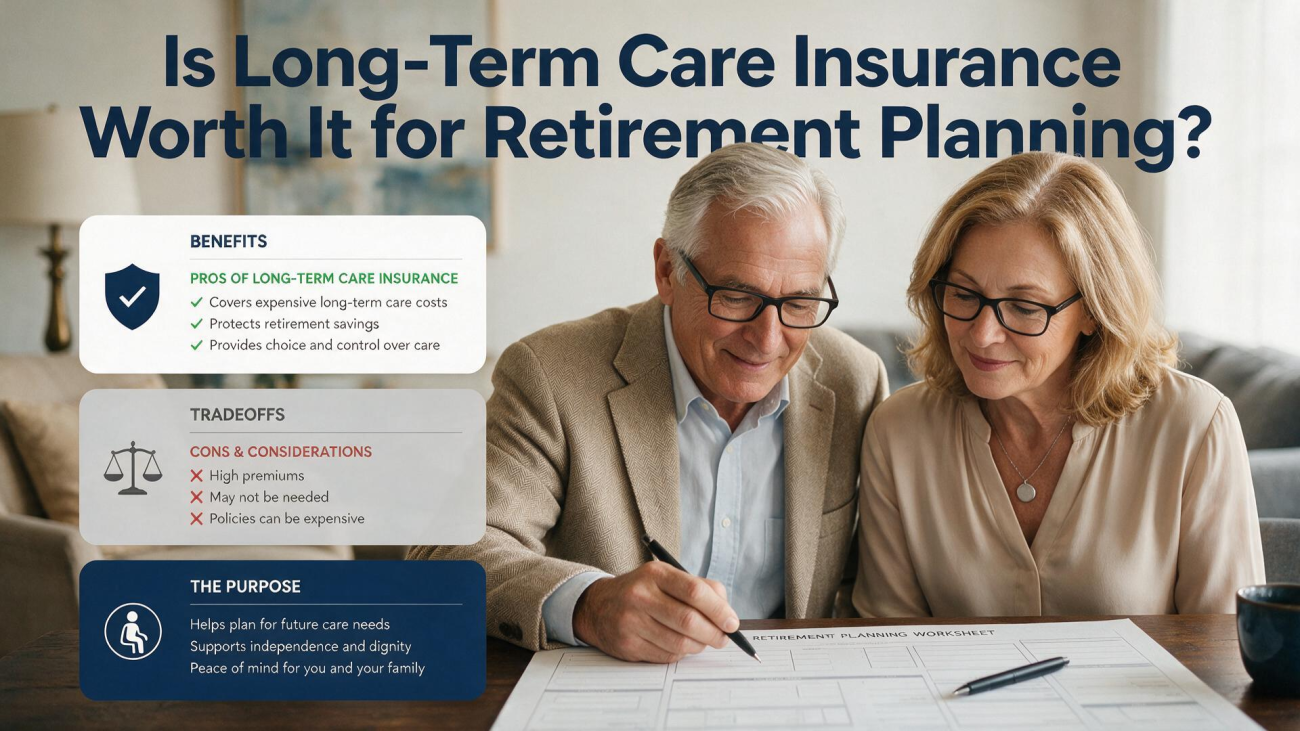
The Question That Keeps Retirees Up at Night
There's a specific kind of anxiety that shows up in the years before retirement. It's not the fear of running out of money in the ordinary sense. It's the fear of a single event—a stroke, a fall, a diagnosis of dementia—that could wipe out decades
of careful saving in a matter of months. Long-term care costs in the United States have reached levels that would stagger most families. A semi-private room in a nursing home runs about $114,975 a year, and a private room pushes past $129,000 [citation:3]. In many markets, the monthly bill for nursing home care now averages around $10,000, and in high-cost areas it can be triple that [citation:8]. Medicare doesn't cover custodial care, the kind that most people actually need [citation:4]. So the question becomes unavoidable: is long-term care insurance worth it, or is it a product that costs too much and pays too little?The answer isn't a simple yes or no. It depends on your assets, your health, your family history, and your tolerance for risk. But the debate has become more
nuanced in recent years as the insurance market itself has evolved. Traditional policies have become harder to find and more expensive, while hybrid products that combine life insurance or annuities with long-term care benefits have gained popularity . Understanding the is long term care insurance worth it question means looking at both the numbers and the psychology behind the decision.What makes this particularly difficult is that the risk isn't symmetrical. Most people won't have a catastrophic long-term care event. They might need a few months of home care after a surgery, or a year in assisted living before passing away. Those costs are manageable for many retirees. But a minority—roughly one in five—will need care for more than five years, and for those people, the financial impact can be devastating . The insurance exists to protect against that tail risk, not to make every care event cost-free.
What the Numbers Actually Say
The cost of coverage has risen significantly over the past decade, and that's made the value proposition harder to evaluate. A 55-year-old man in select health can buy a traditional policy with $165,000 in initial benefits for about $950 a year without inflation protection. With 3% compound inflation protection, which grows the benefit pool to roughly $400,000 by age 85, the premium jumps to around $2,200 a year [citation:12]. For a couple both aged 55, the combined premium for comparable coverage with 3% inflation growth is about $5,050 annually [citation:12]. Those are meaningful sums, especially for retirees on fixed incomes.
But the comparison isn't between the premium and zero. It's between the premium and the potential out-of-pocket cost of care. If a policy pays $5,000 a month for three years, that's $180,000 in benefits. If the same money had been invested and grown at 6%, a $2,200 annual premium over thirty years might accumulate to roughly $175,000. The math is close, which is why the decision often comes down to risk tolerance rather than pure arithmetic. Insurance isn't about expected value. It's about transferring a risk you can't afford to keep.
The senior care insurance costs also have to be weighed against the alternative of self-funding. If you have $2 million in liquid assets and a comfortable retirement budget, you might be able to absorb a $300,000 care event without derailing your plan. If you have $500,000 and a modest pension, the same event could exhaust your savings and leave your spouse in a precarious position. The insurance makes the most sense for people in the middle—enough assets to protect, but not enough to self-insure comfortably [citation:6].
What Coverage Actually Provides
The coverage side of the equation matters as much as the cost, and it's where many buyers misunderstand what they're getting. Long-term care insurance doesn't pay for everything. It typically covers custodial care—help with bathing, dressing, eating, transferring, and other activities of daily living—when you can no longer perform them independently. It may cover care in a nursing home, assisted living facility, adult day program, or at home. But it usually has a daily or monthly benefit cap, an elimination period before benefits begin, and a maximum benefit period or lifetime pool [citation:11].
The long term care benefits that matter most are inflation protection and the definition of eligibility. Without inflation protection, a policy purchased at 55 with a $165,000 benefit pool will still have a $165,000 pool at 85, when care costs may have doubled or tripled. With 3% compound inflation, that pool grows to about $400,000 over the same period [citation:12]. Skipping inflation protection to save on premiums is one of the most common mistakes, because it leaves the policy paying far less than expected when it's actually needed.
Eligibility is the other critical piece. Most policies pay benefits when you can't perform at least two of six activities of daily living without assistance, or when you have a severe cognitive impairment like dementia [citation:11]. That's a reasonable trigger, but it means the policy won't pay for preventative care, occasional help around the house, or the kind of informal support that families often provide. The insurance is for the period when care becomes a genuine necessity, not for the early stages when it's still a convenience.
The Hybrid Alternative
The traditional long-term care insurance market has contracted in recent years, with fewer carriers offering standalone policies and premiums rising for those that remain. That's pushed many buyers toward hybrid products, which combine life insurance or an annuity with a long-term care rider . The appeal is obvious: if you never need care, your beneficiaries get a death benefit. If you do need care, the policy pays for it. The money isn't wasted either way.
Hybrid policies typically require a single premium or a limited number of payments, which makes them easier to budget for than lifelong traditional premiums that can increase over time. They also tend to have more predictable pricing, because the insurance company isn't exposed to the same long-term care cost inflation risk that made traditional policies unprofitable for many carriers. The retirement insurance strategies that use hybrids often frame them as a way to protect assets while also leaving something for heirs, which addresses the psychological barrier that keeps people from buying traditional coverage.
The trade-off is that hybrids usually offer less long-term care benefit per dollar of premium than traditional policies. A traditional policy providing $180,000 in LTC benefits might cost a 55-year-old man about $1,050 a year. A comparable hybrid with the same LTC benefit and a $120,000 death benefit might cost more upfront, though the exact figures depend on the carrier and structure [citation:12]. The hybrid is more expensive in pure benefit terms, but it solves the "what if I never use it" problem that makes traditional insurance feel like a gamble.
The Case for Buying—and the Case for Skipping
The strongest argument for buying long-term care insurance isn't about the money. It's about the care itself. Research and anecdotal evidence suggest that people with insurance are more likely to seek quality care rather than making do with informal arrangements or family reliance . When you have a policy that pays for professional care, you're more likely to use it. When you're paying out of pocket, there's a tendency to minimize costs, even at the expense of your own well-being. For people who value independence and quality of life in their later years, that's a meaningful benefit that doesn't show up in a spreadsheet.
The case for skipping is equally legitimate. If you have substantial assets—say, $2 million or more in liquid investments—you can likely self-fund a care event without jeopardizing your retirement. If you have very modest assets, Medicaid will eventually cover nursing home care after you've spent down your resources, though the process is complicated and the care may be limited [citation:5]. The people in the middle are the ones for whom insurance makes the most sense, because they have enough to lose but not enough to absorb a catastrophic loss comfortably.
Health status is the other deciding factor. If you have a family history of dementia or a condition that's likely to require care, the insurance becomes more valuable. If you're in excellent health with no family history of long-term care needs, the probability of a catastrophic event is lower, and the insurance is less essential. The retirement healthcare planning process should include an honest assessment of your risk factors, not just a generic calculation.
Making the Decision
The decision about long-term care insurance is ultimately a personal one, and there's no universal right answer. What matters is that you make it consciously, rather than avoiding it and hoping for the best. The worst outcome isn't buying insurance you never use. It's needing care, not having insurance, and watching your retirement savings disappear while your family scrambles to figure out what to do.
If you decide to explore coverage, start early. The best time to apply is in your 50s or early 60s, while you're still healthy enough to qualify and premiums are lower [citation:6]. Get quotes from multiple carriers, and compare the definitions, inflation protection, and benefit periods carefully. Don't just compare premiums. A cheaper policy with weak inflation protection or a restrictive eligibility definition may cost you far more in the long run.
And if you decide not to buy, that's a decision too. It means committing to a self-funding strategy, setting aside a dedicated reserve for care costs, and being honest with your family about what you've planned and what you haven't. The is long term care insurance worth it question doesn't have a single answer. It has your answer, based on your assets, your health, and your priorities. The important thing is to answer it before you're forced to.
