The Tax Bill You Choose, Not the One You Owe
Most investors treat capital gains taxes as an unavoidable cost of investing. You buy something, it goes up, you sell it, and the government takes a slice. That framing is understandable, because it's how the default tax system works. But it's
not the only way it works. The tax code gives investors a remarkable amount of control over when and how they pay capital gains taxes, and the investors who understand that control keep significantly more of their returns than the ones who don't. The difference between a tax-blind portfolio and a tax-aware one can be several percentage points a year, and over decades, that difference compounds into a meaningful gap in wealth. Capital gains tax strategies aren't about avoiding taxes. They're about paying the tax on your schedule, at the lowest rate available, and keeping the rest working for you.The mechanics are straightforward once you see them. Long-term capital gains—gains on assets held for more than a year—are taxed at preferential rates, currently 0%, 15%, or 20% depending on income, plus the 3.8% net investment
income tax for high earners. Short-term gains—gains on assets held for a year or less—are taxed as ordinary income, at rates up to 37%. That distinction alone is the single most powerful tax planning tool available to most investors. Simply holding assets for more than a year can cut the tax rate on the gain by more than half. The capital gains tax planning that works starts with that basic rule.What makes this particularly important right now is that the tax treatment of capital gains is more favorable than it's been in years, but it's also subject to political risk. The current rates are the result of legislation that could change, and high earners have a real incentive to realize gains while the rates are favorable. The how to reduce capital gains tax conversation isn't just about minimizing the tax in any single year. It's about timing the realization of gains to take advantage of favorable rates and to avoid the years when rates are higher.
The Power of Long-Term Holding
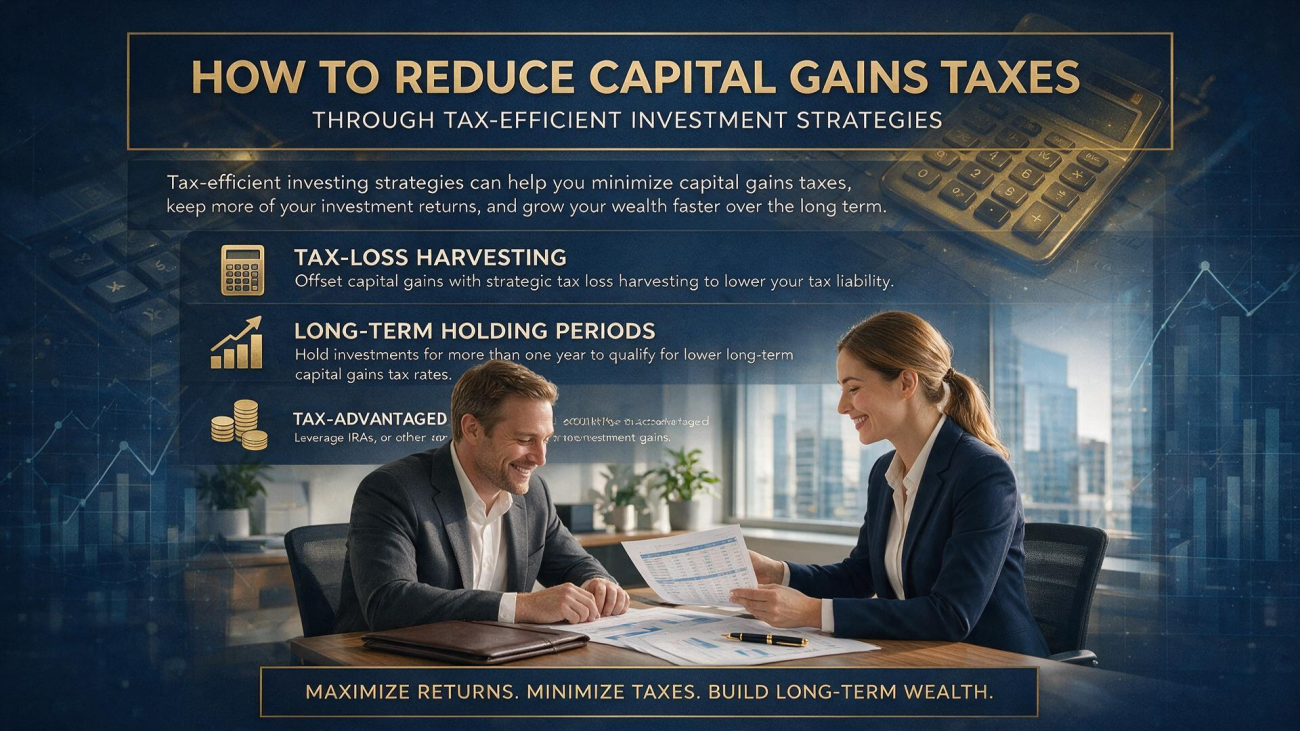
The first and most important strategy is to hold investments for more than a year. The difference between short-term and long-term capital gains rates is dramatic. An investor in the 37% bracket who sells an asset held for 11 months pays 37% on the gain. The same investor who waits one more month and sells at the 13-month mark pays 20% plus the 3.8% net investment income tax, for an effective rate of 23.8%. That's a difference of more than 13 percentage points, and it's entirely within the investor's control. The capital gains tax strategies that work start with the simple discipline of holding for the long term.
The long-term holding rule applies to individual securities, but it also applies to funds. A mutual fund that trades frequently can generate short-term gains that are distributed to shareholders, even if the shareholder held the fund for years. That's why tax-efficient investors favor index funds and ETFs, which tend to have lower turnover and generate fewer short-term distributions. The tax efficient investing that works uses funds that are designed to minimize taxable distributions, not just funds that have performed well.
There's a nuance worth understanding about the holding period. The clock starts on the day after the purchase, and the asset must be held for more than one year to qualify for long-term treatment. That means if you buy on January 1, you need to hold until January 2 of the following year to be safe. The one-day difference matters, and investors who sell on the anniversary date can inadvertently trigger short-term treatment. The capital gains tax planning that works pays attention to those details, because a single day can make a significant difference in the tax bill.
It's also worth considering the role of tax-loss harvesting in the long-term holding strategy. When an investment declines in value, selling it to realize the loss can offset gains elsewhere in the portfolio, which reduces the tax bill. The loss can be used to offset capital gains, and up to $3,000 per year can offset ordinary income. Any excess loss can be carried forward to future years. The how to reduce capital gains tax that works uses tax-loss harvesting systematically, especially in years when the market is volatile.

Asset Location and Account Structuring
The second major strategy is asset location—placing the right investments in the right accounts. The tax treatment of an investment depends not just on what it is, but on which account holds it. A high-yield bond held in a taxable account generates interest that's taxed as ordinary income every year. The same bond held in an IRA grows tax-deferred, with no annual tax bill. A growth stock held in a taxable account can appreciate for years without triggering any tax until it's sold, while the same stock held in a traditional IRA is taxed as ordinary income when withdrawn. The investment tax optimization that works places the least tax-efficient assets in tax-advantaged accounts and the most tax-efficient assets in taxable accounts.
The practical application is straightforward. Tax-inefficient assets—high-yield bonds, REITs, actively managed funds with high turnover—should be held in tax-deferred or tax-free accounts like 401(k)s, traditional IRAs, and Roth IRAs. Tax-efficient assets—broad index funds, individual stocks held for the long term, municipal bonds—should be held in taxable accounts. That placement reduces the annual tax drag on the portfolio and allows the tax-advantaged accounts to grow without the interruption of annual taxes. The tax efficient investing that works considers asset location alongside asset allocation, because both affect the after-tax return.
Roth accounts deserve special attention. A Roth IRA or Roth 401(k) grows tax-free, and qualified withdrawals are tax-free. That makes Roth accounts the best place to hold assets that are expected to appreciate the most, because the growth will never be taxed. The capital gains tax strategies that work use Roth accounts for the highest-growth assets, and traditional accounts for the income-generating assets, which is the opposite of what many investors do by default.
It's also worth considering the role of a health savings account. An HSA offers a triple tax advantage: contributions are deductible, growth is tax-free, and withdrawals for qualified medical expenses are tax-free. That makes it one of the most tax-efficient accounts available, and it's particularly valuable for high-income investors who can afford to pay medical expenses out of pocket and let the HSA balance grow for decades. The investment tax optimization that works uses HSAs as a supplemental retirement account, not just a way to pay current medical bills.
Charitable Giving and Gain Avoidance
The third strategy is charitable giving, which can eliminate capital gains taxes entirely on appreciated assets. When you donate appreciated securities to a charity or a donor-advised fund, you avoid the capital gains tax you would have paid if you sold them, and you get a deduction for the fair market value of the donation. That's a double benefit that can significantly increase the after-tax value of the gift. The capital gains tax planning that works uses appreciated securities for charitable giving whenever possible, because the tax savings are substantial.
Donor-advised funds are particularly useful for this strategy. A DAF allows you to make a charitable contribution, take the deduction in the year of the contribution, and then recommend grants to charities over time. That's valuable in years when income is unusually high, because the deduction can offset a larger portion of the tax liability. It also allows you to separate the timing of the tax deduction from the timing of the charitable grants, which gives you more flexibility. The how to reduce capital gains tax that works uses DAFs to front-load deductions in high-income years and to simplify charitable giving.
Charitable remainder trusts are another tool for eliminating capital gains taxes on appreciated assets. A CRT allows you to contribute appreciated assets to a trust, which sells them without triggering capital gains tax, and then pays you an income stream for a term of years or for life. The remainder goes to charity. The capital gains tax strategies that work use CRTs for investors who have highly appreciated assets and want to diversify without paying a large tax bill.
It's also worth considering the role of opportunity zones, which offer tax benefits for investing in designated low-income communities. Investments in qualified opportunity funds can defer capital gains taxes, reduce them if held for five years, and eliminate them entirely if held for ten years. The program has been criticized for benefiting wealthy investors more than the communities it was designed to help, but for investors who qualify, the tax benefits are significant. The investment tax optimization that works evaluates opportunity zones as part of a broader tax strategy, not as a standalone investment.
Timing and Tax Brackets
The fourth strategy is timing the realization of gains to take advantage of tax brackets. The capital gains rates are progressive, which means the rate you pay depends on your taxable income. An investor in the 0% bracket pays no capital gains tax, an investor in the 15% bracket pays 15%, and an investor in the 20% bracket pays 20%. That means there are opportunities to realize gains at a lower rate by timing them in years when income is lower, or by spreading gains over multiple years. The capital gains tax planning that works considers the investor's income trajectory and realizes gains in the years when the rate is lowest.
Retirement is a particularly important period for this strategy. Many retirees have lower taxable income than they did during their working years, which means they may qualify for the 0% or 15% capital gains rate. Realizing gains in those years, or converting traditional IRA assets to Roth assets, can take advantage of the lower rate. The how to reduce capital gains tax that works includes a retirement income plan that considers the capital gains rate alongside the ordinary income rate.
It's also worth considering the interaction between capital gains and other income. A large capital gain can push an investor into a higher bracket, which increases the tax on other income as well. That's why spreading gains over multiple years, or realizing them in years when other income is lower, can be more tax-efficient than realizing them all at once. The capital gains tax strategies that work consider the full picture of the investor's income, not just the gain itself.
Finally, remember that tax planning is a means, not an end. The goal isn't to avoid paying tax; it's to keep more of your returns working for you. A strategy that reduces taxes but also reduces returns, or that adds complexity you don't need, isn't a good strategy. The tax efficient investing that works is the investing that balances tax efficiency with returns, simplicity, and peace of mind. Work with a tax advisor who understands investments, and an investment advisor who understands taxes. The coordination between the two is where the real savings come from, and it's the difference between a portfolio that grows and one that grows and keeps more of what it earns.
