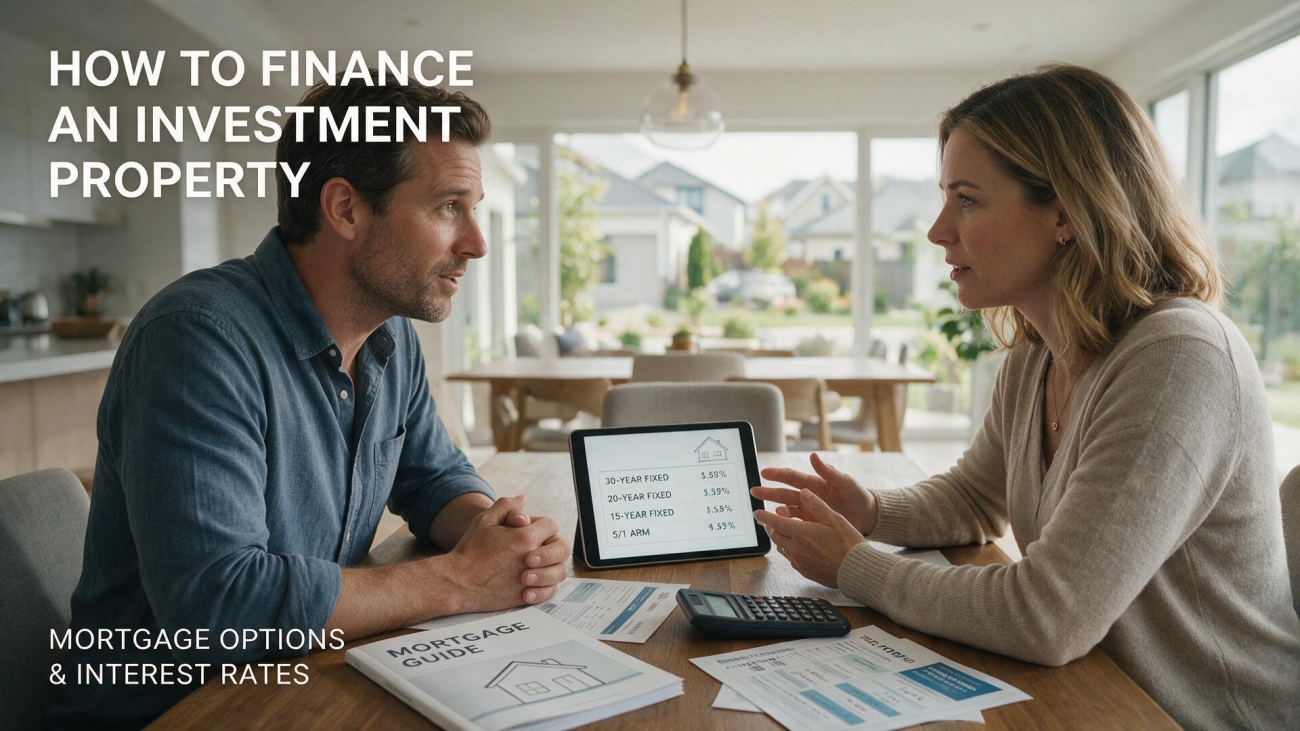
Financing Is Where Most Real Estate Investors Get It Wrong
Most real estate investors spend their time thinking about the property: the location, the condition, the rent roll, the neighborhood. Those things matter enormously, but they're not the whole story. The financing structure is
what determines whether a good property becomes a great investment or a financial trap. The wrong loan can eat your cash flow, leave you exposed to rate increases, or force you to sell at the worst possible time. The right loan can amplify your returns, protect your downside, and give you the flexibility to hold through a downturn. The investment property mortgage you choose is as important as the property you buy, and understanding the options is essential for anyone serious about building wealth through real estate.The financing landscape for investment properties is different from the mortgage market for primary residences. Lenders view investment properties as riskier because the borrower doesn't live there, and the
loan is often dependent on the rental income rather than the borrower's salary. That risk premium shows up in higher interest rates, larger down payment requirements, and stricter qualification standards. The investment property financing market is also more varied, with options ranging from conventional loans to portfolio loans, hard money, and government-backed programs, each with its own terms and trade-offs.What makes this particularly important right now is that interest rates have risen significantly from their lows a few years ago, and the cost of financing has changed the math on many deals. A property that cash-flowed comfortably with a 3% mortgage might barely break even with a 6.5% mortgage. That means the financing decision is more consequential than it's been in years, and the difference between a competitive rate and a mediocre one can be the difference between a profitable investment and a money pit. The rental property mortgage rates you're quoted will shape your returns for decades, which is why shopping the market is not optional.
The Main Loan Types for Investment Properties
Conventional loans are the most familiar option. These are the loans that are backed by Fannie Mae and Freddie Mac, and they're available through most banks and mortgage brokers. For investment properties, conventional loans typically require a 20% to 25% down payment and a credit score of at least 620, though the best rates go to borrowers with scores above 740. The investment property mortgage rates for conventional loans are typically 0.5% to 0.75% higher than the rates for primary residences, because the lender is taking on more risk. Conventional loans are a good fit for investors with strong credit, stable income, and the ability to make a substantial down payment.
Government-backed loans, including FHA and VA loans, are also available for some investment properties, though the rules are restrictive. FHA loans can be used for properties with up to four units, but the borrower generally must occupy one of the units as a primary residence. VA loans are similar—they're available for owner-occupied properties, not pure investment properties. Those programs are less useful for investors who don't plan to live in the property, but they can be valuable for house hackers who buy a multi-unit property and live in one unit while renting the others. The real estate investment loans that work for those investors often combine favorable government financing with rental income from the other units.
Portfolio loans are a third option, offered by smaller banks and credit unions that keep the loans on their own books rather than selling them to Fannie Mae or Freddie Mac. Those lenders have more flexibility in their underwriting, which can be valuable for investors with complex income situations, multiple properties, or credit issues. The property financing options that portfolio lenders provide often come with higher rates and shorter terms, but they can be the right choice for investors who don't fit the conventional mold.
Hard money loans are a fourth option, used primarily by fix-and-flip investors and those who need to close quickly on distressed properties. Hard money lenders are private investors or small companies that lend based on the property's value rather than the borrower's income, and they charge significantly higher rates—often 10% to 15%—with points and fees that add to the cost. The real estate investment loans that hard money lenders provide are not for long-term holds, but they can be valuable for short-term projects where speed and flexibility matter more than cost.
How Rates Are Determined
The rental property mortgage rates you're quoted are influenced by several factors, some of which you can control and some of which you can't. The first is the broader interest rate environment. Mortgage rates are tied to the yield on the 10-year Treasury and to the Federal Reserve's monetary policy. When rates are rising, mortgage rates tend to rise with them, and when rates are falling, mortgage rates tend to fall. That's why the timing of a purchase can significantly affect the cost of financing, even if the property's price is the same.
The second factor is your credit score. Borrowers with higher scores get lower rates, because the lender perceives less risk. The difference can be substantial—a borrower with a 760 score might get a rate that's 0.5% to 1.0% lower than a borrower with a 660 score, which translates to tens of thousands of dollars over the life of the loan. The investment property financing that's most cost-effective is the financing that's secured after the borrower has optimized their credit profile, not before.
The third factor is the loan-to-value ratio. Lenders charge higher rates for loans with higher LTVs, because the borrower has less equity and the lender has less cushion if the property declines in value. A borrower who puts 25% down will typically get a better rate than one who puts 15% down, and a borrower who puts 40% down will get a better rate still. The property financing options that work for an investor depend on how much capital they can commit to the down payment, and the rate difference can be significant.
The fourth factor is the property type. Lenders charge higher rates for properties they consider riskier—multi-family properties with more than four units, mixed-use properties, and properties in declining areas all carry higher rates. The real estate investment loans that work for a specific property depend on its characteristics, and a property that's considered risky by one lender might be considered acceptable by another.
Choosing Between Fixed and Adjustable Rates
One of the most consequential decisions in investment property financing is whether to choose a fixed-rate or adjustable-rate mortgage. A fixed-rate mortgage locks in the interest rate for the life of the loan, typically 15 or 30 years. That provides certainty and protects the borrower from rising rates, which is valuable for a long-term hold. The investment property mortgage that's fixed provides stability, but it may come with a higher initial rate than an adjustable-rate option.
An adjustable-rate mortgage, or ARM, starts with a lower fixed rate for an initial period—typically three, five, or seven years—and then adjusts periodically based on a benchmark index. The initial rate is lower than a fixed-rate loan, which can improve cash flow in the early years. But when the fixed period ends, the rate can rise significantly, which increases the payment and can squeeze the property's cash flow. The rental property mortgage rates on ARMs are attractive when rates are expected to fall, but they can be a trap when rates are expected to rise or when the borrower can't afford the higher payments.
The right choice depends on the investor's time horizon and risk tolerance. A long-term holder who plans to keep the property for decades may prefer the certainty of a fixed-rate loan, even if the rate is slightly higher. An investor who plans to sell or refinance within a few years may prefer an ARM, because the lower initial rate improves cash flow and the property will likely be sold or refinanced before the rate adjusts. The investment property financing that works is the financing that matches the investor's strategy, not the financing that has the lowest rate on day one.
It's also worth considering the role of interest rate risk in the overall investment. A property with a fixed-rate mortgage is insulated from rate increases, which means its cash flow is predictable and its value is less sensitive to changes in the market. A property with an adjustable-rate mortgage is exposed to rate increases, which means its cash flow can decline and its value can fall if rates rise. The property financing options that work for a conservative investor prioritize stability over the lowest possible rate, because the cost of a rate increase can exceed the benefit of a lower initial payment.
Qualifying for an Investment Property Mortgage
Qualifying for an investment property mortgage is more difficult than qualifying for a primary residence, and the requirements vary by lender and loan type. The first requirement is a down payment of at least 20% to 25% for conventional loans, though some lenders may require more for properties that are considered riskier. The second requirement is a credit score that meets the lender's minimum, typically 620 for conventional loans but higher for the best rates. The investment property mortgage that's approved is the one that meets the lender's criteria, which is why understanding those criteria before applying is essential.
The third requirement is a debt service coverage ratio, or DSCR, that demonstrates the property's income can cover the debt payments. Lenders typically require a DSCR of 1.20 to 1.25, meaning the property's net operating income must be at least 20% to 25% higher than the mortgage payment. That requirement protects the lender against a decline in income or an increase in expenses, and it ensures that the property can service the debt even in a downturn. The rental property mortgage rates that are available depend on the property's DSCR, and a property with a strong DSCR can qualify for better terms.
The fourth requirement is documentation of income and assets. Lenders want to see that the borrower has the income to service the debt and the reserves to cover unexpected expenses or vacancies. That typically means providing tax returns, bank statements, and a personal financial statement. The real estate investment loans that are approved are the ones where the borrower's documentation is complete and consistent, which is why working with a lender who understands investment properties is valuable.
Strategies for Getting the Best Financing
The first strategy is to shop the market. Rates vary significantly between lenders, and the difference can be substantial. A borrower who gets quotes from three or four lenders is likely to find a rate that's 0.25% to 0.5% lower than the first quote they receive, which translates to thousands of dollars over the life of the loan. The investment property financing that's most cost-effective is the financing that's been shopped, not the financing that's accepted from the first lender who responds.
The second strategy is to optimize your credit profile before applying. Paying down credit card balances, disputing errors on your credit report, and avoiding new credit inquiries can raise your score and qualify you for better rates. The rental property mortgage rates that are available to a borrower with a 760 score are significantly better than the rates available to a borrower with a 680 score, and the difference can be worth the effort of improving your credit.
The third strategy is to consider a portfolio lender if you have a complex situation. If you own multiple properties, have irregular income, or have credit issues that conventional lenders won't accept, a portfolio lender may be able to work with you. The property financing options that portfolio lenders provide are more flexible, though they come with higher rates and shorter terms. For some investors, the flexibility is worth the cost.
The fourth strategy is to plan for the long term. A mortgage is a long-term commitment, and the choices you make at the outset will affect your returns for decades. Choosing a fixed-rate loan with a long term provides stability and predictability, even if the initial rate is slightly higher. The investment property mortgage that works for a long-term investor is the one that supports the strategy, not the one that has the lowest rate in the first year. Take the time to get it right, because the financing you choose today will shape your investment for years to come.
