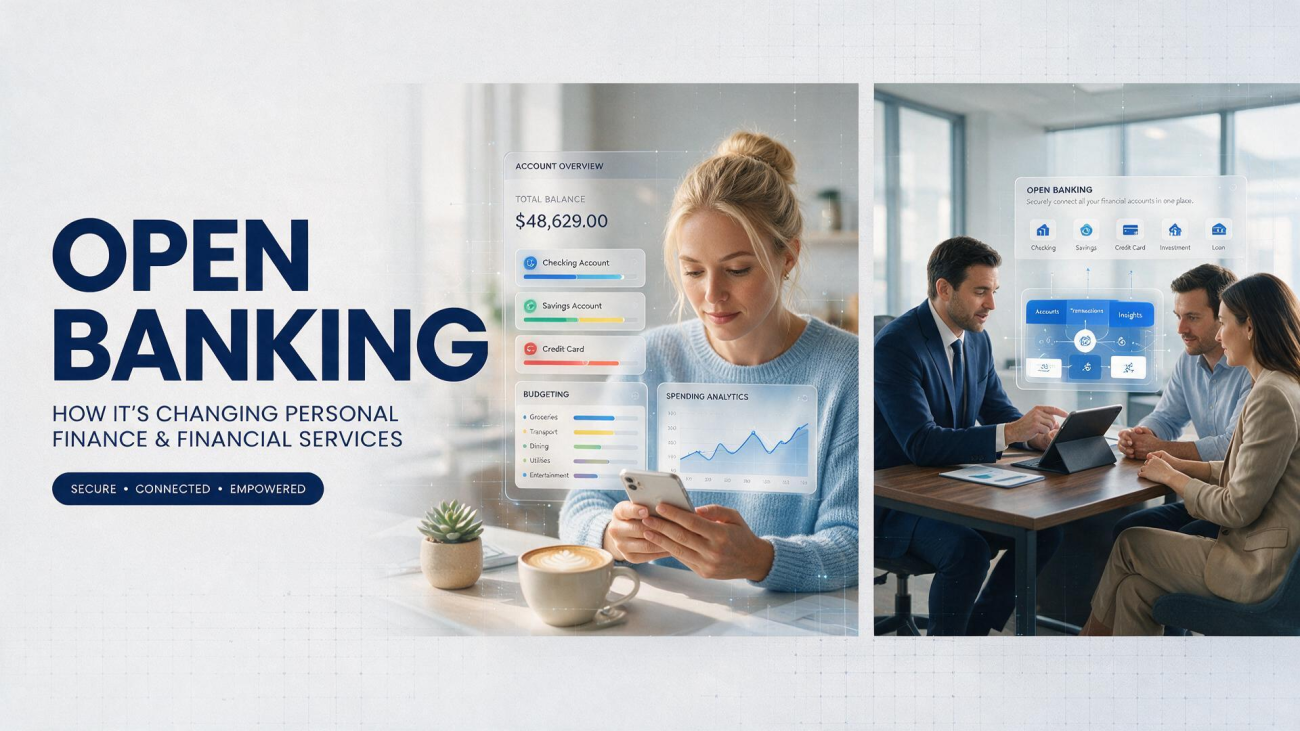
For most of banking history, your financial data lived in silos. Your checking account knew what you spent at the grocery store. Your brokerage knew what you held in your
portfolio. Your mortgage servicer knew your payment history. And none of them talked to each other, at least not in any way that benefited you. You were the integration layer, manually pulling statements and typing numbers into spreadsheets. That arrangement is being dismantled, and the force doing the dismantling has a name that sounds more bureaucratic than revolutionary: open banking.What Open Banking Really Means
Strip away the jargon and open banking is a fairly simple idea. With your permission, your bank shares your financial data with third-party providers through secure, standardized interfaces. That's
it. The implications, though, are enormous. Once data can move freely and securely between institutions, an entire ecosystem of new services becomes possible—budgeting apps that see all your accounts, lenders that can assess your creditworthiness in minutes rather than days, investment platforms that can pull in your full financial picture, and payment systems that don't require you to hand over your bank password to a stranger.The open banking technology that makes this work is built on APIs, or application programming interfaces. Think of an API as a controlled doorway. Instead of giving a third party the keys to your entire house, you let them through a specific door to a specific room for a specific purpose. They can see your transaction history, but they can't move money. Or they can initiate a payment, but only for an amount you've approved. The bank stays in control of the doorway, the third party gets what it needs, and you get the benefit of services that were impossible when data was locked up.
This is a meaningful change from the old way of doing things, which usually involved screen scraping—handing over your login credentials to a third party that would literally log in as you and read the page. That approach worked, but it was fragile and insecure. It broke whenever the bank changed its website, and it meant your password was stored in places you didn't control. APIs replace that with something more robust, and the shift has been underway for years in markets like the UK and Europe, where regulators pushed banks to open up. The US has moved more slowly, but the direction is clear.
The regulatory backdrop matters here. In the US, the Consumer Financial Protection Bureau has been working on rules that would give consumers a legal right to their financial data, which would force banks to provide it through standardized interfaces. The details are still being hammered out, and there's real tension between banks that want to control the pace of change and fintechs that want access. But the broad direction is toward more openness, not less, and the open banking services that exist today are a preview of what's coming.
The Consumer Benefits That Are Already Here
If you've used a budgeting app that pulls in all your accounts, you've already touched open banking, even if the app didn't call it that. Personal finance management tools like Mint, YNAB, and Copilot rely on data connections to give you a unified view of your money. The difference now is that those connections are becoming more reliable and more secure, which means the apps can do more. A budgeting tool that used to break every few weeks can now maintain a continuous connection, which makes the advice it gives you more accurate.
The lending side is where the changes get more interesting. Traditional credit scoring relies on a narrow set of data—payment history, credit utilization, length of credit history. Open banking allows lenders to see a much richer picture: income stability, spending patterns, cash flow. For someone with a thin credit file, that can be the difference between approval and denial. For someone with a blemish on their record but strong financial habits, it can mean a better rate. The financial data integration that makes this possible is changing how risk is assessed, and it's opening up credit to people who were previously shut out.
Payments are another area where the impact is tangible. Open banking allows for direct account-to-account transfers that bypass card networks entirely, which can mean lower fees for merchants and faster settlement. In markets where this has taken off, like the UK, consumers can pay for goods and services directly from their bank account without entering card details. The US is earlier in this journey, but the infrastructure is being built, and the potential is significant. For small businesses especially, the ability to accept payments without paying card processing fees is a real cost saving.
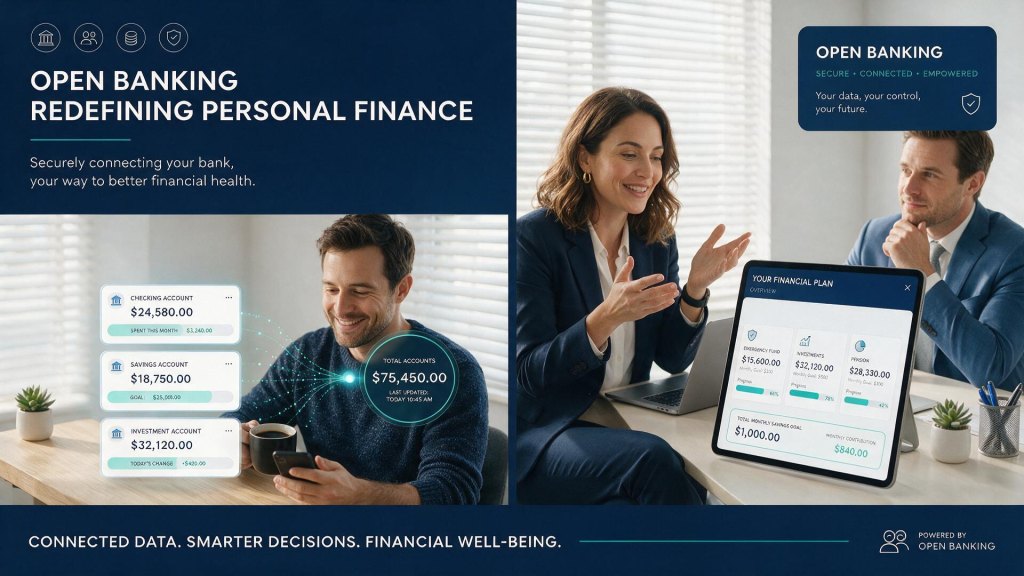
Investment and wealth management are also being reshaped. Platforms can now pull in a complete picture of your assets—bank accounts, brokerage accounts, retirement plans—and use that to provide more holistic advice. A robo-advisor that can see your entire financial life can recommend an allocation that accounts for your emergency fund, your home equity, and your spouse's retirement account, not just the assets it manages. That's a meaningful improvement over advice based on a partial picture, and it's one of the more practical benefits of the digital financial services ecosystem that's emerging.
The Risks Nobody Wants to Talk About
Open banking comes with real risks, and the industry's enthusiasm for the benefits sometimes drowns out honest discussion of them. The most obvious is data security. Every additional party with access to your financial data is a potential point of failure. A fintech that handles data poorly can expose you to fraud or identity theft, and the consequences can take years to untangle. The regulatory framework is supposed to address this through licensing and oversight, but the reality is that the quality of security varies enormously across providers.
Privacy is another concern, and it's subtler than the usual "who has my data" question. Open banking creates a detailed record of your financial behavior that can be analyzed, profiled, and monetized. Even if a provider doesn't sell your data directly, it may use it to build a profile that's shared with partners or used to target products at you. Consumers should understand what they're agreeing to when they connect an account, and the better providers are transparent about their practices. The ones that bury the details in a long agreement are telling you something.
Liability is a third area where the rules are still evolving. If a third party initiates a fraudulent payment using your data, who's responsible? The bank, the third party, or you? The answer depends on the jurisdiction and the specific circumstances, and it's not always clear. This is one of the areas where regulation needs to catch up with technology, because consumers need to know they're protected if something goes wrong. The open banking innovation that's driving new services has to be paired with a liability framework that makes consumers whole when things break.
There's also the question of concentration risk. If a small number of technology providers end up handling data for most of the market, they become a single point of failure for the entire system. An outage or a breach at one of those providers could affect millions of consumers simultaneously. This is a version of the too-big-to-fail problem, transplanted to the data layer, and regulators are only beginning to grapple with it. The industry's push toward consolidation and scale makes this a live concern, not a hypothetical one.
How Banks Are Responding
Banks have had a complicated relationship with open banking. On one hand, it's a threat. If a customer can see all their accounts in a third-party app, the bank's own app becomes less essential, and the bank risks becoming a commodity provider of accounts rather than a primary financial relationship. On the other hand, open banking creates opportunities for banks that embrace it, allowing them to offer services that span institutions and to integrate with the broader ecosystem.
The larger banks have mostly taken a defensive posture, participating in open banking where required but moving slowly and emphasizing security concerns. Smaller banks and credit unions have sometimes moved faster, because open banking allows them to offer capabilities that would otherwise require massive technology investment. A community bank can partner with a fintech to offer sophisticated budgeting tools, for example, without building them from scratch. That's a genuine competitive benefit, and it's one reason the smaller players have been more enthusiastic.
The most interesting response is from banks that are building open banking into their own products. A bank that can pull in your accounts from other institutions can offer a more complete picture of your finances, which makes its advice more valuable and its app stickier. That's a shift from the old model, where banks wanted to keep your data inside their walls. The banks that embrace financial data integration as a feature rather than a threat are positioning themselves for a market where the customer, not the institution, controls where their data goes.
The competitive landscape is still shaking out, and it's not clear which business models will win. What is clear is that the old model—where your financial data was locked inside whichever institution happened to hold your account—is fading. The open banking technology that enables data portability is becoming standard, and the services built on top of it are becoming more sophisticated. Consumers will benefit from more choice and better integration, provided the risks are managed carefully.
What to Watch as the Market Develops
The next few years will determine whether open banking delivers on its promise or gets bogged down in regulatory fights and security failures. The key indicators are straightforward. Watch for standardized APIs that work consistently across institutions, because fragmentation is the enemy of adoption. Watch for clear liability rules that protect consumers when something goes wrong. Watch for providers that are transparent about how they use data, rather than those that hide behind lengthy agreements.
Watch, too, for the services that become possible when data flows freely. The most promising open banking services aren't just better budgeting apps. They're products that use the full picture of a consumer's finances to offer something genuinely new—credit that's priced based on actual behavior rather than a crude score, investment advice that accounts for every account, payments that settle instantly and cheaply. Those are the applications that will justify the investment the industry is making in the infrastructure.
For consumers, the practical advice is to pay attention. You have more control over your financial data than you did a decade ago, and you should exercise it. Connect only the apps you trust, review what permissions you're granting, and disconnect anything you're not using. The digital financial services ecosystem is more powerful than it's ever been, but it's also more complex, and the benefits come with responsibilities. Open banking is a tool, and like any tool, it works best when the person using it understands what it does.
