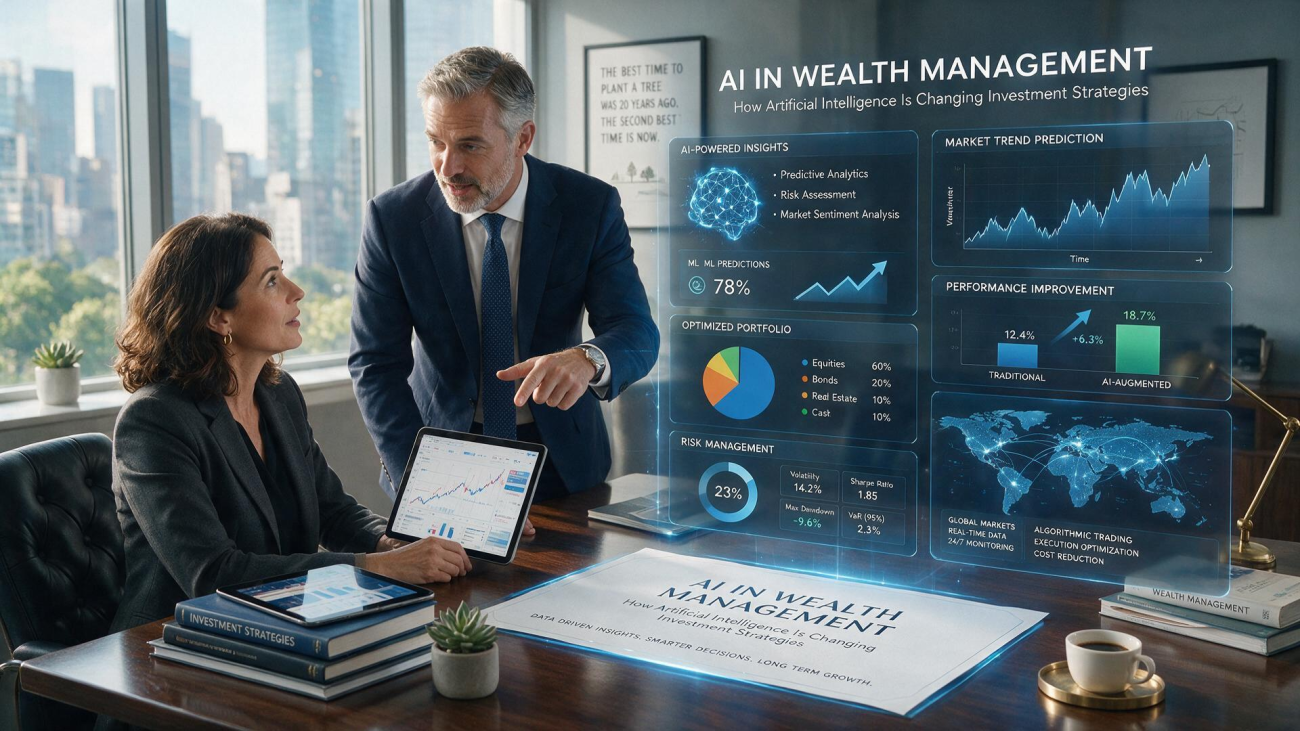
Walk into any wealth management conference these days and you'll hear the same word repeated until it loses all meaning. AI this, AI that, AI everything. Some of it is genuine progress. Some of
it is marketing departments slapping a trendy label on software that's been doing regression analysis since the 1990s. Sorting the real from the hype matters, because the way artificial intelligence is actually reshaping investment strategy is both more modest and more consequential than the buzz suggests. It isn't replacing judgment. It's changing where judgment gets applied, and that shift is already altering how portfolios are built, monitored, and defended.What AI Is Actually Doing Inside Portfolios
The most visible application of AI in wealth management isn't a robot picking stocks. It's the quiet infrastructure sitting underneath the investment process—the models that parse
earnings calls, flag unusual trading patterns, and stress-test portfolios against scenarios nobody has lived through yet. Machine learning systems can digest thousands of data points in the time it takes a human analyst to read one 10-K, and they can do it without getting tired or anchored to a prior view. That matters most in areas where the data is too voluminous or too messy for traditional analysis.Take risk management, where the gains have been most concrete. Traditional risk models rely on historical correlations, which tend to break down exactly when you need them most. AI-driven systems can monitor relationships between assets in real time, flagging when correlations are shifting before a portfolio gets caught offside. They can run thousands of Monte Carlo simulations overnight, incorporating alternative data sources that human analysts wouldn't have time to process. The result isn't a crystal ball, but it is a faster warning system, and in a market that moves in hours rather than weeks, speed has value.
Portfolio construction has also been reshaped, though less dramatically than the headlines suggest. The core principles—diversification, asset allocation, cost control—haven't changed. What's changed is the granularity. AI systems can optimize across thousands of securities and dozens of constraints simultaneously, finding combinations that a human advisor working with a spreadsheet simply couldn't identify. They can incorporate tax considerations at the lot level, rebalancing in ways that harvest losses without triggering unwanted gains. For anyone managing a taxable portfolio of significant size, that kind of precision translates into real money over time.
Client-facing applications are another frontier, and one that's evolving quickly. AI systems can now generate personalized portfolio commentary, answer routine questions, and flag when a client's circumstances have changed in a way that warrants a conversation. That doesn't mean clients want to talk to a chatbot about their retirement. It means the human advisor shows up to the meeting better prepared, with the routine work already done. The best implementations treat AI as a force multiplier for the advisor, not a substitute.
The Real Shift in Investment Strategy
The deeper change isn't about any single tool. It's about how artificial intelligence investing changes the pace at which strategies can be tested and refined. In the old model, an investment thesis would be formulated, backtested against historical data, and then monitored over months or years to see whether it held up. The cycle was slow, and by the time a strategy was validated or invalidated, market conditions had often shifted. AI compresses that cycle, allowing teams to test hypotheses against alternative datasets, run scenarios across regimes, and identify when a strategy is drifting from its intended behavior.
This has implications for how portfolios are managed through market stress. A traditional approach might involve a quarterly review and a committee decision. An AI-augmented approach can monitor dozens of signals continuously and flag when conditions are diverging from the assumptions behind a given allocation. That doesn't mean automatic selling—the system isn't making the call—but it does mean the humans in charge are responding to information rather than waiting for the next scheduled meeting. In practice, that can mean smaller drawdowns and faster recovery, not because the AI is smarter, but because the decision loop is shorter.
There's also a democratization effect that doesn't get enough attention. Sophisticated analytical tools that were once available only to institutional investors are now accessible through AI investment platforms serving individual clients and smaller advisors. A family office with fifty million dollars can now access factor models and risk analytics that would have required a dedicated quant team a decade ago. That's genuinely new, and it's changing the competitive landscape. The edge that used to come from information asymmetry is shifting toward the edge that comes from knowing how to use the tools well.
But the shift also creates new risks. When many firms use similar models trained on similar data, they can end up making similar decisions at similar times, which is a recipe for crowded trades and amplified volatility. The 2010 flash crash and various quant-driven episodes since have shown what happens when automated systems interact in ways their designers didn't anticipate. Regulators are paying attention, and the firms that will do well over the long run are the ones building in circuit breakers, human oversight, and a healthy skepticism about what their models can't see.
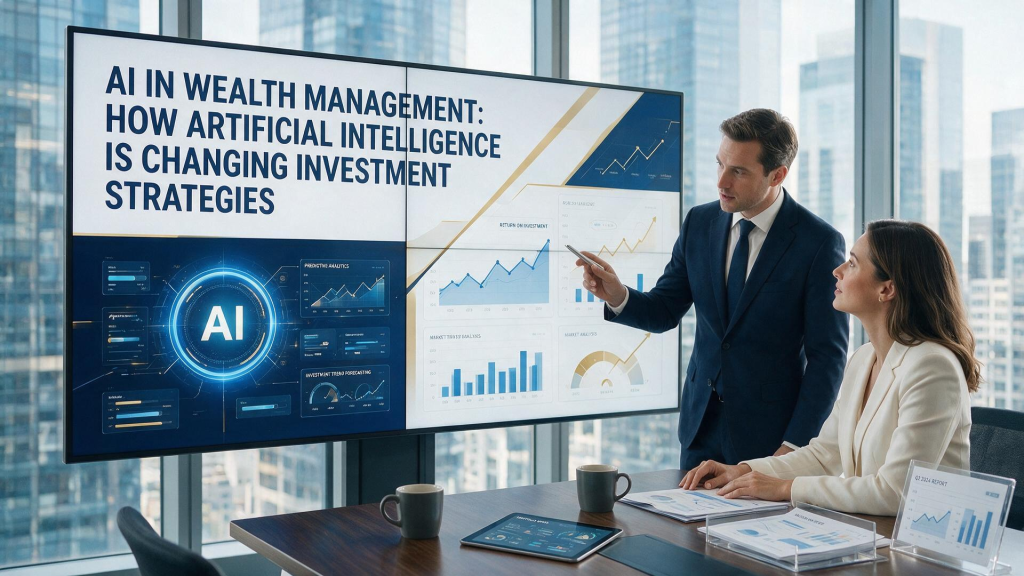
Where AI Financial Planning Delivers for Real People
Step away from the institutional side and the impact on individual planning is easier to see. AI financial planning tools can now model retirement scenarios with a level of detail that used to require a dedicated planner and a lot of spreadsheet work. They can incorporate real-time spending data, project tax implications across decades, and adjust for life events as they happen. For a household with a complex financial life—multiple income streams, a business interest, a rental property, aging parents to support—that capability is genuinely useful.
The better tools go beyond projection and into monitoring. They can flag when spending is drifting above plan, when a portfolio is drifting from its target allocation, or when a life event—a job change, a health issue, an inheritance—requires a planning update. That continuous monitoring is something human advisors can't do for every client at every moment, and it's where automated systems earn their keep. The client feels more supported, and the advisor has better information when the relationship does require a human conversation.
Tax-aware planning is another area where the gains are concrete. AI systems can model Roth conversion strategies across multiple years, identify harvesting opportunities, and coordinate charitable giving with bracket management. These are the kinds of decisions that historically required a CPA and an advisor working closely together, and they often fell through the cracks because coordinating them was too expensive for anyone but the largest clients. Automated tools are making that level of planning accessible to a broader range of households, which is a real improvement.
The caveat is that these tools are only as good as their inputs and their assumptions. A projection built on unrealistic spending assumptions, or a model that ignores sequence risk, will produce confident-looking answers that are wrong. The discipline of good planning—being honest about what you don't know, testing against adverse scenarios, revisiting assumptions regularly—matters more than ever. AI makes the math faster, but it doesn't make the judgment for you.
Automated Portfolio Management Grows Up
The original robo-advisors were simple creatures: a questionnaire, a target allocation, and an algorithm that rebalanced on schedule. They were cheap and they worked, for what they did. What's happening now is a maturation of that concept into something more sophisticated. automated portfolio management has grown to include tax-loss harvesting, direct indexing, factor tilts, and personalized constraints, all delivered through a digital interface at a fraction of the cost of traditional management.
Direct indexing is the most interesting development here. Instead of owning an index fund, the investor owns the individual securities that make up the index. That allows for tax-aware customization—harvesting losses in individual positions, excluding certain companies based on values, and tilting the portfolio toward specific factors. The technology to manage hundreds of individual positions efficiently didn't exist at a reasonable cost until recently, and its availability is changing the calculus for taxable investors. For someone in a high bracket with a long time horizon, the tax alpha from direct indexing can be substantial.
The blending of automated and human advice is where most of the industry is heading. Pure robo-advisors have struggled to grow beyond a certain point because clients eventually want a person to talk to, especially when markets get choppy or life gets complicated. Pure human advisory is expensive and doesn't scale to serve the middle market. The hybrid model—automated portfolio management with access to human advisors when needed—is emerging as the practical answer, and the platforms that execute it well are gaining share.
The question to ask about any automated platform is what happens when it encounters something it wasn't designed for. A market dislocation, a regulatory change, a personal situation that doesn't fit the questionnaire. The better platforms have escalation paths, human review, and clear boundaries around what the automation will and won't do. The worse ones produce confident-sounding output regardless of whether the situation is appropriate, which is a recipe for trouble.
What the Future Looks Like From Here
The trajectory is fairly clear, even if the specifics are not. AI will become more deeply embedded in every stage of the investment process, from data gathering to decision support to reporting. It will become less of a separate category and more of a default capability, the way software became a default part of trading decades ago. The firms that win will be the ones that integrate it seamlessly, rather than treating it as a product to be marketed.
What won't change is the fundamental requirement for judgment. Markets are complex adaptive systems, and no model can anticipate every scenario. The humans who use AI well will be the ones who understand its limitations, question its outputs, and know when to override it. The ones who treat it as an oracle will eventually be disappointed, and their clients will be too. AI in wealth management is a tool, and like any tool, its value depends on the skill of the person wielding it.
For investors, the practical takeaway is to ask better questions. Don't just ask whether a platform uses AI—ask what it does with it, how it's validated, and what happens when it's wrong. Don't assume that a sophisticated model produces better results than a simple one. And don't lose sight of the fundamentals that have always driven good outcomes: low costs, diversification, discipline, and a clear understanding of your own goals. AI can help with all of those, but it can't replace them, and it certainly can't replace the judgment that good planning requires.
