The Number That Tells You Whether the Deal Is Worth Doing
Every rental property investor eventually confronts the same question: is this deal actually good? The answer isn't the purchase price, the monthly rent, or the cap rate alone. It's the
return on investment—the measure of how much profit the property generates relative to the capital you put into it. Rental property ROI is the single most important metric for evaluating a deal, and yet most investors calculate it incorrectly or ignore it entirely. They fall in love with the property, they get excited about the rent, and they skip the math that would tell them whether the investment makes sense. That's a mistake that costs them money for years.The problem is that ROI isn't a single number. It's a family of calculations, each answering a different question. Cash-on-cash return tells you how much cash flow you're getting relative to the cash you invested. Cap rate
tells you the property's unlevered yield. Total return includes appreciation and principal paydown, not just cash flow. The rental property profitability that matters depends on which measure you're using and what you're trying to accomplish. An investor seeking income cares about cash-on-cash return. An investor seeking long-term wealth cares about total return. An investor comparing properties across markets cares about cap rate. Understanding the differences is the first step toward making good decisions.What makes this particularly important right now is that interest rates have risen and property prices remain high in many markets. The easy deals of the low-rate era are harder to find, which means the math matters more than ever. A property that looked profitable with a 3% mortgage might barely break even with a 6.5% mortgage. The rental property cash flow that seemed comfortable in the projections can disappear when the actual expenses and financing costs are factored in. Running the numbers carefully before you buy is the only way to avoid a deal that looks good on paper but loses money in practice.
Cash-on-Cash Return: The Income Investor's Metric
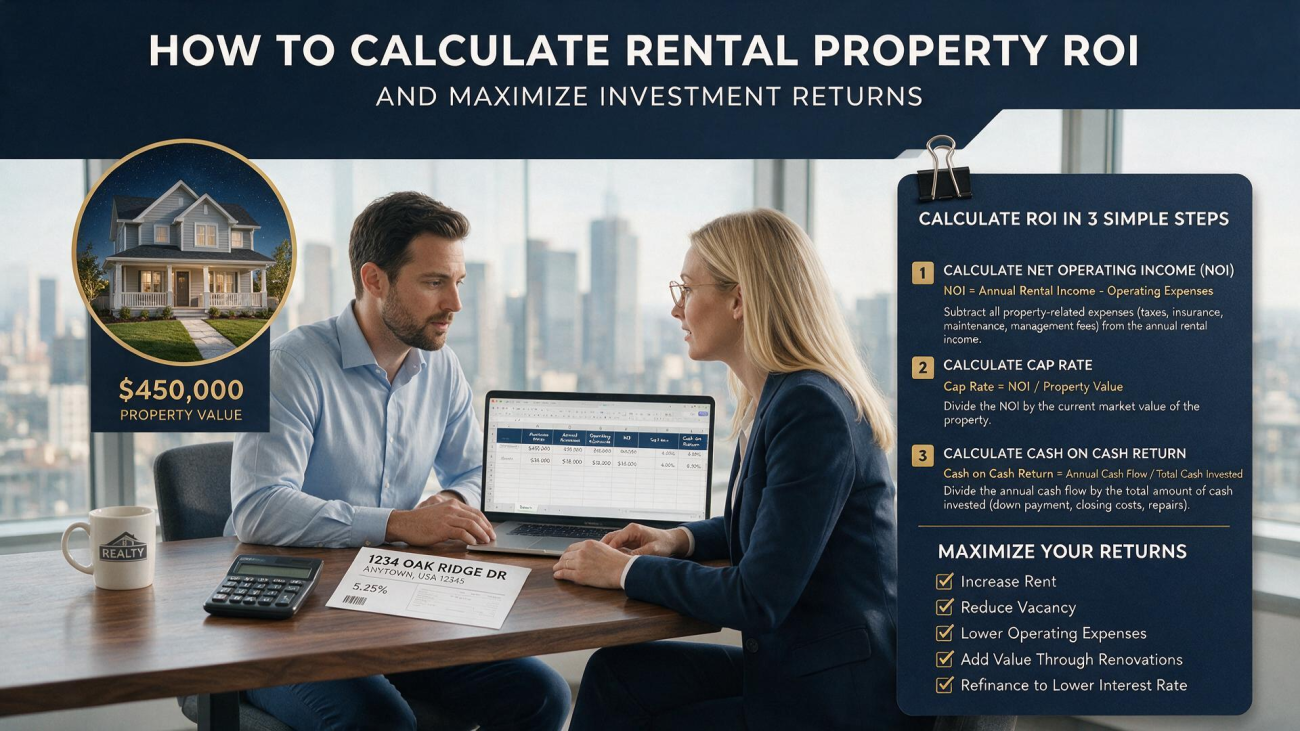
Cash-on-cash return is the most important metric for investors who are focused on cash flow. It measures the annual cash flow the property generates relative to the cash you invested to acquire it. The formula is straightforward: annual pre-tax cash flow divided by the total cash invested. If you put $50,000 down on a property and it generates $5,000 in annual cash flow after all expenses and debt service, your cash-on-cash return is 10%.
The key word is cash. Cash-on-cash return doesn't include appreciation, principal paydown, or tax benefits. It measures only the cash that lands in your bank account each year, which is what you need to cover your living expenses or reinvest in other properties. For investors who are building a portfolio for income, cash-on-cash return is the metric that matters most, because it tells you how quickly the property is returning your capital. The investment property returns that investors rely on for income are driven by that cash flow, and a property with a strong cash-on-cash return is a property that can support itself and generate a profit.
Calculating cash-on-cash return requires an accurate accounting of all the expenses. That includes the mortgage payment, property taxes, insurance, property management fees, maintenance and repairs, vacancy allowance, and any HOA fees. It's easy to underestimate those costs, especially maintenance and vacancy, and a property that looks profitable on a gross rent basis can be a money pit once the real expenses are included. The rental property ROI that's accurate is based on realistic expense assumptions, not optimistic ones.
It's also worth noting that cash-on-cash return is sensitive to the financing structure. A property financed with a larger down payment will have a lower cash-on-cash return, because the cash invested is higher. A property financed with a smaller down payment will have a higher cash-on-cash return, because the leverage amplifies the return on the cash invested. The rental property cash flow that works for a specific investor depends on their financing strategy, their tolerance for risk, and their goals.

Cap Rate: The Unlevered Yield
Cap rate, short for capitalization rate, measures the property's unlevered yield—the return it would generate if you bought it with all cash. The formula is net operating income divided by the property's value or purchase price. Net operating income is the property's income minus its operating expenses, before debt service and income taxes. A property that generates $30,000 in net operating income and is valued at $500,000 has a cap rate of 6%.
Cap rate is the metric that institutional investors use to compare properties across markets and property types. It's a measure of the property's inherent yield, independent of the financing structure, which makes it a useful benchmark for evaluating whether a property is priced fairly. A cap rate that's lower than the market average suggests the property is expensive, while a cap rate that's higher suggests it's a bargain. The rental property profitability that's sustainable is the profitability that's reflected in the cap rate, not just in the cash flow after financing.
Cap rates vary significantly by market and by property type. A property in a high-growth market like Austin or Nashville might trade at a 4% cap rate, because investors are willing to accept a lower yield in exchange for expected appreciation. A property in a slower-growth market like Cleveland or Memphis might trade at an 8% cap rate, because investors demand a higher yield to compensate for lower appreciation. The investment property returns that investors earn are shaped by the cap rate at purchase, because it determines the income yield that the property generates.
It's important to understand that cap rate isn't the same as ROI. Cap rate measures the property's income yield, while ROI measures the return on the investor's equity. A property with a 5% cap rate can produce a 15% cash-on-cash return if it's financed with a large mortgage, because the leverage amplifies the return on equity. The rental property cash flow that's available to the investor depends on the financing, even though the cap rate doesn't.
Total Return: The Long-Term Investor's Metric
Total return is the most comprehensive measure of a rental property's performance. It includes cash flow, appreciation, principal paydown, and any tax benefits. It's the metric that matters for investors who are building wealth over the long term, because it captures all the ways a property generates value, not just the cash it produces each month.
Appreciation is the biggest component of total return for most long-term investors, even though it's the least predictable. A property that appreciates 3% a year will double in value in roughly 24 years, which means the investor's equity can grow significantly even if the cash flow is modest. Principal paydown is the second component—each mortgage payment reduces the loan balance, which increases the investor's equity without any additional capital outlay. The rental property ROI that includes appreciation and principal paydown is much higher than the cash-on-cash return, especially for properties that are held for decades.
Tax benefits are the third component. Depreciation allows the investor to deduct a portion of the property's value each year, which reduces taxable income even if the property is generating cash flow. That deduction is recaptured when the property is sold, but in the meantime it provides a significant tax advantage that increases the after-tax return. The rental property profitability that matters for high-income investors includes those tax benefits, because they can be substantial.
Calculating total return requires estimating future appreciation, which is inherently uncertain. A conservative approach is to use the historical appreciation rate for the market and property type, adjusted for the specific property's condition and location. The investment property returns that are realistic are based on conservative assumptions, not on optimistic projections. A property that looks like a great investment with 5% appreciation might be a mediocre investment with 2% appreciation, and the difference matters.
Using a Real Estate Investment Calculator
Running the numbers for a rental property is complex enough that most investors use a calculator rather than doing the math by hand. A real estate investment calculator can compute cash-on-cash return, cap rate, total return, and a range of other metrics, and it can model different scenarios to see how the returns change with different assumptions. Those tools are valuable, but they're only as good as the inputs.
The first input is the purchase price and acquisition costs. That includes the purchase price, closing costs, inspection costs, and any immediate repairs or renovations. Those costs are part of the cash invested, which means they affect the cash-on-cash return. The rental property ROI that's accurate includes all the acquisition costs, not just the purchase price.
The second input is the income. That includes the monthly rent, any additional income from parking, laundry, or other sources, and a vacancy allowance. The vacancy allowance is critical—it's the percentage of the year that the property is expected to be vacant, and it reduces the effective income. A property with a 5% vacancy allowance is expected to be vacant for about 18 days a year, which is a reasonable assumption for most markets. The rental property cash flow that's realistic includes a vacancy allowance, because no property is occupied 100% of the time.
The third input is the expenses. That includes property taxes, insurance, property management fees, maintenance and repairs, HOA fees, and utilities if they're paid by the owner. It's easy to underestimate those costs, especially maintenance and repairs, which can be significant for older properties. The rental property profitability that's accurate uses realistic expense estimates, not the optimistic numbers in the seller's marketing materials.
The fourth input is the financing. That includes the loan amount, the interest rate, the loan term, and the closing costs. Those inputs determine the monthly mortgage payment and the cash invested, which in turn affect the cash-on-cash return. The investment property returns that matter are the returns after financing, not the unlevered returns, because most investors use leverage to acquire properties.
Maximizing Returns Over Time
Calculating ROI is the first step. Maximizing it is the second. There are several strategies for improving a rental property's returns over time, and they don't all require buying a different property. The first is to raise rents. If the property is rented below market, raising the rent to market level can significantly increase the cash flow. The rental property ROI that improves over time is the ROI that's managed actively, not the ROI that's assumed at purchase.
The second strategy is to reduce expenses. Renegotiating insurance, appealing property taxes, and using a more cost-effective property manager can reduce the operating costs and increase the net operating income. Those changes might seem small, but they add up over time, especially for a property that's held for decades. The rental property cash flow that improves is the cash flow that's managed with attention to expenses.
The third strategy is to add value through renovations. A kitchen update, a bathroom remodel, or a new roof can allow the property to command higher rent and attract better tenants. Those improvements cost money, but they can increase the property's income and value, which improves both the cash-on-cash return and the total return. The rental property profitability that's maximized is the profitability that's improved through strategic capital investment.
The fourth strategy is to refinance when rates fall. If interest rates decline, refinancing the mortgage can lower the monthly payment and increase the cash flow. That's particularly valuable for investors who bought properties when rates were higher. The investment property returns that are maximized are the returns that are managed through the full cycle, with refinancing when it's advantageous and holding when it's not.
Finally, remember that ROI is a tool, not a goal. The goal is to build wealth over time, and ROI is one measure of how well you're doing that. A property with a 15% cash-on-cash return but no appreciation is less valuable than a property with a 6% cash-on-cash return and strong appreciation, because the total return is what matters over decades. The rental property ROI that works for you is the ROI that aligns with your goals, your risk tolerance, and your time horizon. Calculate it carefully, review it regularly, and make decisions based on the full picture, not just the number that looks best on a spreadsheet.
