The decision between a robo-advisor and a traditional financial advisor has become one of the more practical questions in personal finance, and it's one that a lot of people get wrong because they frame it
as a binary. It isn't. These are different tools built for different problems, and the honest answer for most households is that the right choice depends on the complexity of their finances, their tolerance for managing things themselves, and how much they're actually getting for the fee they pay. The gap between the two models has narrowed over the years, which makes the comparison more interesting than it used to be.The Cost Question, Examined Honestly
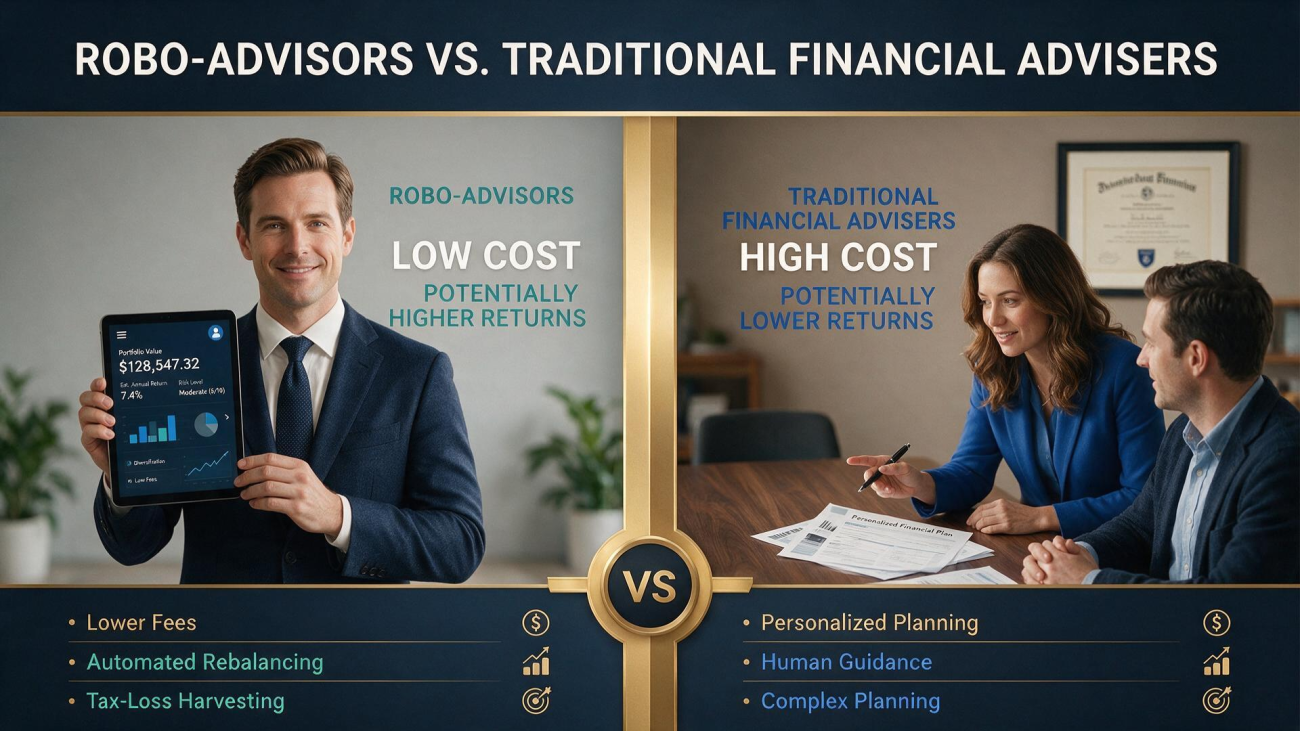
Start with fees, because that's where the conversation usually starts. Robo-advisors typically charge somewhere between 0.25 percent and 0.50 percent of assets under management annually, and some of the leaner options
are cheaper still. Traditional advisors usually charge around 1 percent, sometimes more for smaller accounts and sometimes a bit less for very large ones. On a $500,000 portfolio, that difference is roughly $3,000 to $4,000 a year, and over a couple of decades the compounding effect of that gap is substantial. The robo advisor fees advantage is real and it's the single biggest reason the automated model has gained traction.But comparing headline fees is only part of the story. A traditional advisor's fee usually covers a broader range of services—financial planning, tax coordination, estate planning conversations, help with major life decisions, and someone to call when markets get ugly. A robo-advisor's fee typically covers portfolio management and not much else, though the better platforms are adding planning tools and access to human advisors at higher tiers. If you need comprehensive planning and you hire a separate planner to get it, the cost gap narrows considerably. The fair comparison isn't robo fee versus advisor fee. It's total cost of the services you actually need.
There's also the cost of mistakes to consider. A cheap platform that leaves you in the wrong allocation, or that you abandon during a downturn, can end up costing more than an expensive advisor who keeps you disciplined. Behavioral research consistently shows that investor returns lag fund returns by a meaningful margin, largely because of poor timing decisions. An advisor who prevents one panicked sell during a bad quarter can pay for years of fees in a single conversation. That's hard to quantify, but it's real, and it's the argument traditional advisors lean on most heavily.
Hidden costs deserve a mention too. Robo-advisors often use their own funds or a limited menu of ETFs, which can carry expense ratios that vary widely. Traditional advisors may recommend products that generate commissions or revenue-sharing arrangements, and those costs aren't always transparent. The best robo advisors publish their fund expense ratios clearly, and the best traditional advisors operate as fiduciaries with fee-only structures. Whatever model you choose, look past the advisory fee to the all-in cost, including fund expenses and any transaction costs.
What You Actually Get for the Money
The service gap is where the two models diverge most sharply. A traditional advisor offers a relationship. Someone knows your situation, remembers the conversation you had two years ago about your mother's health, and can connect the dots between your investment portfolio and your estate plan. That continuity is valuable, especially for families with complicated finances or significant life transitions. The advisor becomes a kind of financial quarterback, coordinating with your CPA and attorney and keeping the whole picture in view.
Robo-advisors, by contrast, are built for efficiency and scale. They handle the mechanics of automated investment management well—rebalancing, tax-loss harvesting, dividend reinvestment, and the day-to-day work that most people don't want to think about. They're excellent at keeping you invested according to a plan. What they're not great at is helping you figure out what the plan should be when your circumstances change in a way that doesn't fit the questionnaire. A robo-advisor can tell you your portfolio is on track for retirement, but it can't tell you whether you should take the buyout your employer is offering.
The hybrid model has emerged as a practical middle ground, and it's where a lot of the industry is heading. Many platforms now offer digital portfolio management with access to human advisors, either on-demand or at a higher asset tier. That gives you the low-cost automation for the routine work and a person to talk to when something complex comes up. The quality varies enormously—some hybrid offerings are essentially a call center, while others provide genuine planning support—so it's worth understanding what the human access actually includes before you sign up.
For younger investors with straightforward situations, the robo-advisor case is strong. Low costs, good automation, and a plan that's probably better than what they'd build on their own. For investors with complex situations—a business, multiple properties, aging parents, an estate to plan—the traditional advisor's broader scope is often worth the fee, provided the advisor is competent and the relationship is a good fit. The trick is being honest with yourself about which category you're in.
Performance: What the Data Actually Shows
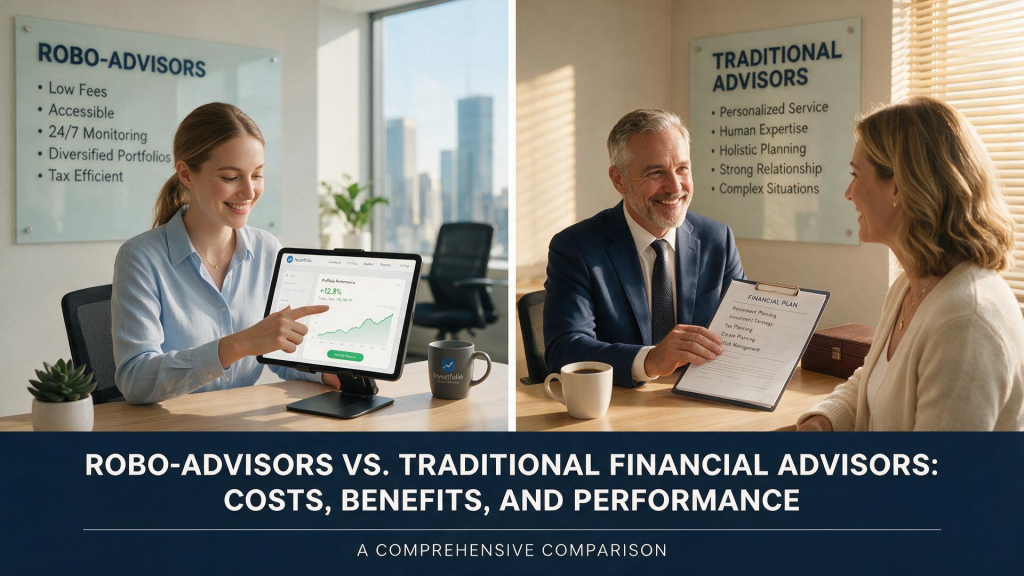
The performance comparison is murkier than either side likes to admit. At the portfolio level, robo-advisors and traditional advisors are often building similar things: diversified portfolios of index funds or ETFs, allocated according to risk tolerance and time horizon. When the underlying holdings are similar, the gross returns are similar too, which means the net returns are driven primarily by fees. That's the core argument for the automated model, and it's a strong one for investors who don't need the broader service offering.
Where the picture gets more complicated is behavior. The value of advice isn't just in the portfolio—it's in the decisions made around the portfolio. Research from Vanguard and Morningstar has consistently estimated the value of good advice in the range of one to three percent annually, driven by behavioral coaching, tax management, and better allocation decisions. If an advisor delivers that value, the fee is easily justified. If they don't—if they're just collecting a fee and putting you in the same index funds a robo-advisor would use—then you're paying for a service you're not receiving.
Automated platforms have gotten better at capturing some of that value themselves. Tax-loss harvesting, which was once a differentiator reserved for wealthier clients, is now standard on many digital investment platforms. Automated rebalancing keeps portfolios from drifting. Direct indexing, available on some platforms, allows for tax-aware customization that used to require an advisor. The gap in technical capability has narrowed, and in some areas the automated platforms are actually ahead.
The performance question also depends on the time period you're looking at. In a long bull market, both models tend to look good and the fee difference dominates. In a sharp downturn, the behavioral gap becomes more visible, and clients with access to a good advisor often fare better because they stay invested. That's not a knock on robo-advisors—it's a recognition that the hardest part of investing isn't picking the portfolio, it's sticking with it when it's uncomfortable. Any honest comparison of robo advisor vs financial advisor has to account for that reality.
Matching the Tool to the Person
The most useful way to think about this is to match the tool to the person, rather than trying to declare a winner. A tech-savvy investor in their thirties with a 401(k), a brokerage account, and a straightforward retirement goal probably doesn't need to pay one percent for portfolio management. A robo-advisor will do the job well at a fraction of the cost, and the automated planning tools will be sufficient for the decisions they're facing.
A business owner in their fifties with a complex tax situation, a defined benefit plan, and a desire to retire in ten years is a different story. That person needs coordinated advice—retirement projections, tax planning, estate considerations, business succession—and a robo-advisor can't provide it. The traditional advisor's fee is buying something real in that case, and the comparison should be between competing advisors, not between an advisor and an app.
The in-between cases are where it gets interesting. A dual-income household in their forties with a couple of million dollars, a mortgage, kids heading to college, and aging parents is dealing with enough complexity that planning support is valuable, but not so much that they need a full family office. The hybrid model—digital portfolio management with access to a planner—often fits best, provided the human access is substantive rather than cosmetic. It's worth asking specific questions about who you'll talk to, how often, and what they can help with.
It's also worth revisiting the decision periodically. The robo-advisor you choose at thirty may not be sufficient at fifty, and the traditional advisor you hire at fifty may be more than you need at seventy when your finances simplify. The relationship should evolve with your life, and neither model is a permanent commitment. The digital investment platforms have made switching easier than it used to be, which is a healthy development for the industry as a whole.
The Bottom Line for Most Households
For most households, the decision comes down to a simple question: is your financial situation complex enough to justify paying for human judgment, and is the advisor you're considering actually delivering that judgment? If the answer is yes, the traditional model is worth the fee. If the answer is no, the automated model is likely to serve you better, at a lower cost, with fewer distractions.
The mistake to avoid is paying for one model and getting the other. A traditional advisor who puts you in a standard portfolio and doesn't provide meaningful planning is essentially an expensive robo-advisor. A robo-advisor that leaves you without support during a difficult market is failing at one of the core jobs of financial advice. The robo advisor vs financial advisor comparison isn't about which model is better in the abstract. It's about which one, in your specific situation, delivers the most value for the money you're spending.
As the industry continues to evolve, the line between the two models will blur further. Automated platforms will add more human support, traditional advisors will adopt more technology, and the pricing will converge somewhat. What won't change is the fundamental trade-off: you can pay less for automation and handle more yourself, or pay more for human judgment and delegate more. Neither choice is wrong. The important thing is to make it deliberately, with your eyes open about what you're actually getting.
