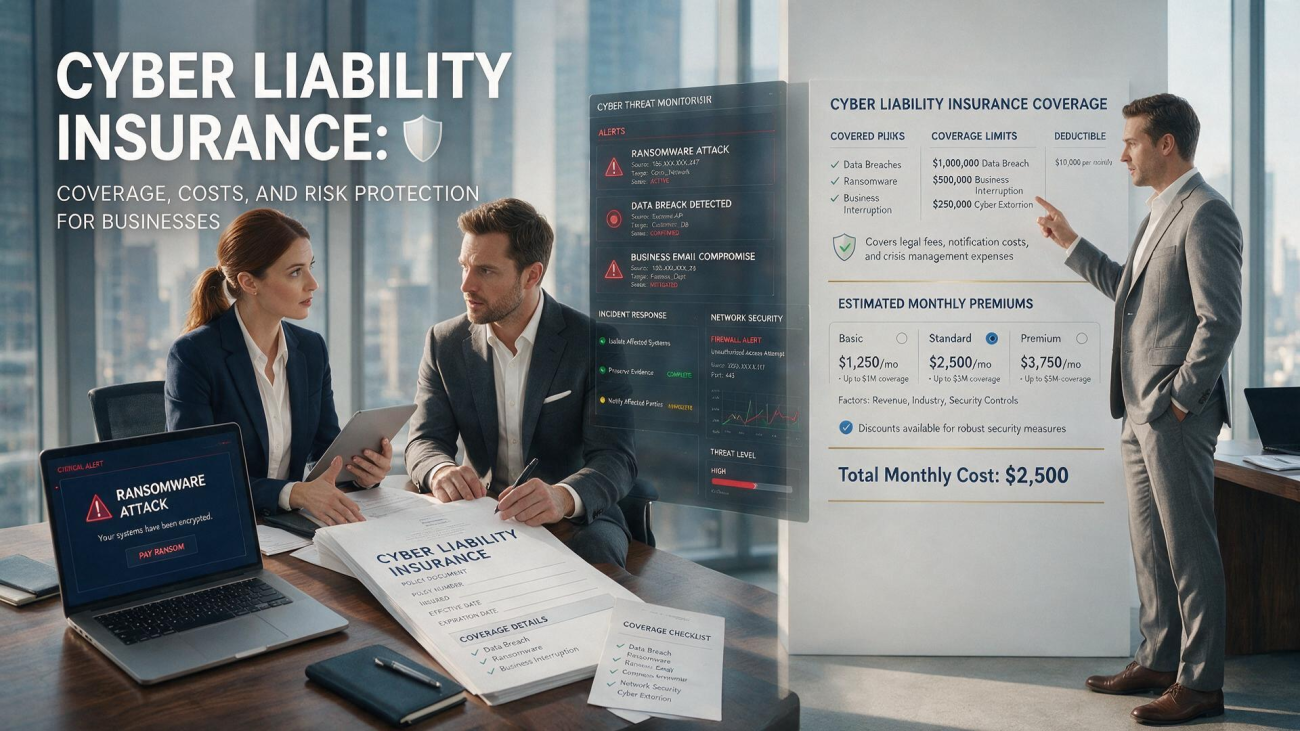
The Attack You Don't See Coming Is the One That Costs the Most
Most business owners insure the things they can see: the building, the equipment, the inventory, the vehicles. Those are tangible assets, and the risks to them are obvious. But the asset that's most
valuable and most vulnerable in a modern business is often invisible. It's the customer data, the employee records, the payment information, the proprietary files, and the systems that keep the business running. A cyberattack doesn't need a key to the front door. It can arrive through an email, a compromised vendor, or a weak password, and it can shut down operations, expose sensitive information, and trigger legal liabilities that dwarf the cost of any physical loss. Cyber liability insurance exists to transfer that risk, and for most businesses, it's no longer optional.The stakes are higher than the headlines suggest. Willis examined 5,500 cyber claims across 95 countries and found that the average ransomware event lasts 25 days and generates an average loss of $5.3 million [citation:3][citation:8].
Those figures include business interruption, ransom payments, and recovery costs, and they're not limited to large enterprises. Small and medium-sized businesses are increasingly targeted, because they often have valuable data and weaker defenses than larger companies. The cyber insurance cost for a small business is a fraction of that potential loss, which is why the coverage has moved from a niche product to a core part of business risk management.What makes cyber insurance particularly important right now is the gap it fills. General liability policies typically exclude cyber risks, and property policies don't cover data or business interruption caused by a network outage. Without a dedicated cyber policy, a business that suffers a breach is paying for forensic investigators, notification costs, legal defense, regulatory fines, and lost income out of pocket. The business cyber risk protection that works is the coverage that addresses those specific costs, not the coverage that assumes a traditional liability policy will somehow respond.
What Cyber Liability Insurance Actually Covers
Cyber insurance policies are not standardized, and the coverage varies significantly by carrier and by the endorsements attached to the policy. But most standalone policies include two broad categories of coverage: first-party losses and third-party liabilities [citation:11]. Understanding the difference is essential for evaluating whether a policy is adequate for your business.
First-party coverage pays for the costs your business incurs directly because of a cyber incident. That includes breach response costs like forensic investigation, legal advice, notification expenses, credit monitoring for affected individuals, and crisis management or public relations [citation:1][citation:11]. It also includes business interruption coverage, which pays for lost income and extra expenses when a cyber event prevents the business from operating normally. Data recovery costs, which pay to restore or recreate lost or damaged data, are typically included. And cyber extortion coverage pays for the costs of responding to a ransomware demand, including negotiation and the ransom payment itself, subject to the policy's sublimits [citation:11].
Third-party coverage pays for liabilities your business owes to others because of a cyber incident. That includes privacy liability, which covers legal defense and settlements when a data breach exposes personal information and affected individuals sue. It also includes network security liability, which covers claims that your systems were used to transmit malicious code or cause damage to another organization's network. Regulatory liability covers the costs of defending against investigations or actions by regulators like the FTC, state attorneys general, or HIPAA enforcement, including fines and penalties where insurable by law [citation:1]. Media liability covers claims of defamation, copyright infringement, or other reputational harms related to your online content.
The coverage terms matter enormously. Sublimits are common, especially for ransomware, regulatory fines, and social engineering fraud. A policy with a $1 million limit might have a $100,000 sublimit for ransomware, which means the most expensive and most likely cyber event is only covered up to a fraction of the headline limit [citation:7]. The cybersecurity insurance coverage that works for your business is the coverage that has sublimits appropriate to your risk profile, not just a headline limit that looks adequate until you read the fine print.

What It Costs and What Drives the Price
The cost of cyber liability insurance varies enormously based on the size of the business, the industry, the amount of sensitive data handled, and the security controls in place. For small businesses, published averages range from about $129 to $145 per month for a policy with $1 million in coverage, with many businesses paying less than $100 per month [citation:2]. Annual costs typically fall between $1,200 and $2,400 for businesses under $1 million in revenue, and rise to $2,400 to $5,000 for businesses with $1 million to $10 million in revenue [citation:7].
Industry is the single biggest pricing factor. Healthcare practices, financial services firms, law firms, and businesses that handle payment card data pay significantly more than construction companies, manufacturers, or restaurants, because the data they hold is more sensitive and the regulatory exposure is higher [citation:7][citation:12]. A physician's office might pay $8,000 to $30,000 a year for coverage that costs a landscaper a few hundred dollars, because the potential loss from a breach of medical records is so much greater [citation:12]. The cyber insurance cost for your business reflects the specific data you handle and the regulations that apply to it.
Security controls are the biggest factor you can control. Carriers offer significant credits, often 10% to 25%, for documented controls like multi-factor authentication, endpoint detection and response, employee phishing training, and tested backups [citation:7]. Some carriers won't even quote a policy without MFA on email and remote access, because it's such a fundamental protection. A business that completes the security questionnaire honestly and has strong controls can pay 30% less than a business with comparable revenue but weaker defenses [citation:7]. The data breach insurance that's affordable is the coverage that's paired with real security practices, not the coverage that's bought as a substitute for them.
Claims history matters too. A single prior cyber claim, even one that's fully resolved, can increase your premium 25% to 50% for three to five years, and multiple claims may make some carriers decline entirely [citation:7]. That's why prevention matters not just for avoiding the incident itself, but for keeping your insurance costs manageable over time. The cyber liability insurance market rewards businesses that take security seriously, and it penalizes those that don't.
The Ransomware Problem and Why Sublimits Matter
Ransomware deserves special attention because it's the cyber risk that's most likely to produce a catastrophic loss, and it's the coverage that's most often limited by sublimits. The Willis data shows that ransomware accounts for the highest financial severity of any cyber loss type, driven primarily by business interruption and downtime rather than the ransom payment itself [citation:8]. The average ransom demand is $3.8 million, and the average payment is $1.5 million, but those figures are only part of the cost. The 25-day average duration of a ransomware event means lost productivity, disrupted customer service, and damaged reputation that can persist long after the systems are restored [citation:3].
Many cyber policies cap ransomware coverage at a sublimit that's well below the overall policy limit. A policy with a $1 million limit might have a $250,000 ransomware sublimit, which leaves the business exposed to the rest of the cost if the event is severe [citation:7]. Some carriers exclude ransomware payments entirely or impose conditions on when they'll pay. The cyber liability insurance that works for a business with significant ransomware exposure is the policy with a ransomware sublimit that matches the potential loss, not the policy with the lowest premium.
The good news is that ransomware coverage is evolving. More carriers are offering dedicated ransomware and cyber extortion coverage with higher sublimits, and some are integrating incident response services into the policy. The business cyber risk protection that works includes not just the insurance payout but the resources to respond quickly when an attack happens, because the first 24 to 48 hours are critical for limiting the damage [citation:9]. A policy that pays the claim but takes days to engage a forensic team is less valuable than one that responds immediately.
Building a Program That Actually Protects the Business
Buying cyber insurance isn't a set-it-and-forget-it exercise. The coverage needs to be reviewed annually, the limits need to be adjusted as the business grows and the data it handles changes, and the security controls need to be maintained to keep the premiums affordable and the coverage valid. The cyber insurance cost is only part of the equation. The value comes from having coverage that responds when an incident happens, and that requires understanding what the policy actually covers before you need it.
The first step is to assess your risk honestly. What data do you store? How many records? What regulations apply to your industry? What would happen if your systems went down for a week? What would a breach cost in notification, legal defense, and regulatory fines? The cybersecurity insurance coverage that works is the coverage that's sized to those answers, not the coverage that's chosen because it's the cheapest option or because a broker recommended it without asking questions.
The second step is to work with a broker who specializes in cyber. The policies vary significantly, the sublimits matter more than the headline limits, and the exclusions can be traps. A specialist knows which carriers are strongest for your industry, which sublimits to negotiate, and which exclusions to push back on. The data breach insurance that works is the policy that's been reviewed carefully, not the one that's been bought on price alone.
The third step is to pair the insurance with real security practices. Insurance is a safety net, not a substitute for locking the doors. Multi-factor authentication, endpoint detection, employee training, tested backups, and an incident response plan are the controls that reduce the likelihood of an incident and the severity when one occurs. They're also the controls that keep your premiums down and your coverage valid. The cyber liability insurance that protects the business is the policy that's part of a broader risk management strategy, not the only line of defense.
Finally, review the policy every year and after any significant change. A policy that was adequate when the business had 1,000 customer records may be inadequate when it has 100,000. A policy that didn't include regulatory defense costs may need that coverage when the business expands into a regulated industry. The cyber insurance cost will change as the business changes, and the coverage should change with it. That ongoing attention is what turns a policy into genuine protection, and it's what gives the business the best chance of recovering when the worst happens.
